
Tesamorelin Injection Frequency Research Explained
By PeptCalc Research — Medically reviewed by David Mansour, MD — Last reviewed July 21, 2026
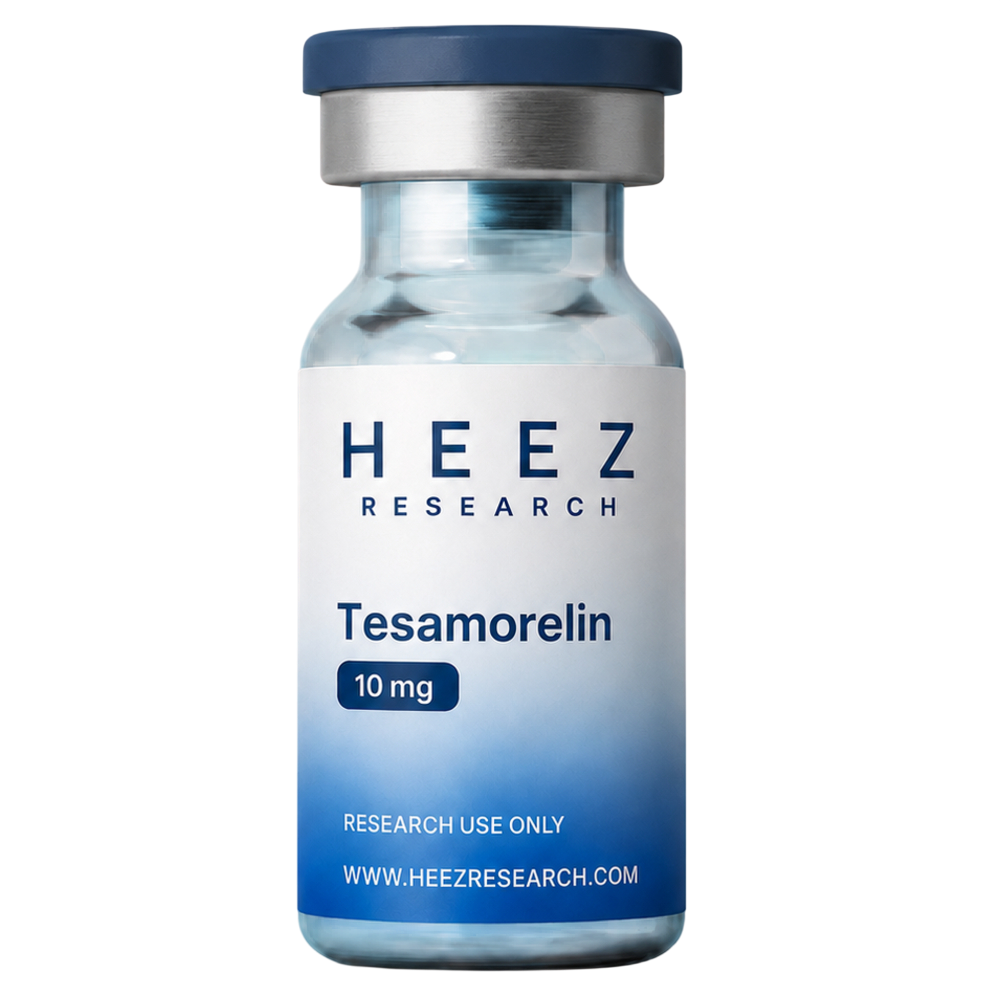
Tesamorelin is available at HEEZ Research
This calculator performs arithmetic on the numbers you enter. It is not medical advice, does not tell you what dose to take, and is not a substitute for guidance from a qualified clinician.
Tesamorelin's injection frequency is not a matter of preference — it is set by the FDA-approved label, and research protocols that study tesamorelin generally follow the same schedule. This reference lays out what the label specifies, why a growth-hormone-releasing peptide is typically dosed daily rather than weekly, and how that frequency interacts with the reconstitution math that determines how many doses a single vial holds. It is written for research and educational purposes only and is not medical advice.
What the approved label specifies
Tesamorelin's only FDA-approved formulation is marketed as EGRIFTA and EGRIFTA SV, indicated for HIV-associated lipodystrophy. The label, indexed on DailyMed (NIH/NLM), specifies a 2 mg subcutaneous injection once daily. That approval covers a single, specific condition — it does not extend to any other use, and DailyMed's label language should not be read as guidance for unapproved research applications. It is cited here for one narrow reason: it is the only regulatory-grade source that states a verified tesamorelin injection frequency.
Outside that approved indication, tesamorelin is studied and discussed as a research compound. Independent research protocols are not bound to the approved label, but the ones that specify a frequency generally converge on the same once-daily pattern, for a pharmacological reason rather than a regulatory one — covered next.
Why once daily, not weekly
Tesamorelin belongs to a class of peptides called growth-hormone-releasing hormone (GHRH) analogs. These peptides work by prompting a pulse of growth hormone release, and they clear from circulation quickly rather than persisting for days. A peptide that clears fast cannot sustain an effect from a single weekly injection the way a longer-acting compound can — the signal fades well before the next dose would arrive.
That short duration of action is the practical reason both the approved label and most research protocols use daily dosing. It is not a dosing preference; it follows from how quickly the compound is cleared. This is also why comparing tesamorelin's frequency to a long-acting peptide's weekly schedule is not a fair comparison — the two classes clear the body on entirely different timelines, and frequency is a downstream consequence of that difference, not an independent design choice.
Frequency and the reconstitution math
Injection frequency answers a different question than reconstitution math does. Frequency tells you how many times per period you draw from the vial. Reconstitution math tells you the concentration of what's in the vial, and therefore the volume — and syringe units — for any single dose. The two combine to answer a third question: how many days will one vial last at a given frequency?
Concentration is set once, at the moment bacteriostatic water is added:
Concentration = vial mass (mg) ÷ water added (mL)
A common reference setup for tesamorelin scales water to vial size at 1 mL per 10 mg, holding concentration at 10 mg/mL across the common 10 mg, 20 mg, and 30 mg vial sizes. That concentration doesn't change no matter how often you draw from the vial — only the running total of mg withdrawn changes.
Worked example: vial life at a daily frequency
Setup. A 30 mg tesamorelin vial reconstituted with 3 mL of bacteriostatic water.
Step 1 — concentration. 30 mg ÷ 3 mL = 10 mg/mL.
Step 2 — volume per dose. At a 2 mg dose (the approved label's amount), volume = 2 mg ÷ 10 mg/mL = 0.2 mL.
Step 3 — syringe units. On a U-100 insulin syringe, 1 mL = 100 units, so 0.2 mL × 100 = 20 units per injection.
Step 4 — vial life at once-daily frequency. The 30 mg vial holds 30 ÷ 2 = 15 full doses. At one injection per day, that vial supplies 15 days before a new vial is needed.
Change any one input and the vial-life number changes with it. A 20 mg vial at the same 10 mg/mL concentration holds 10 doses — 10 days at a daily frequency. A lower daily amount, such as a 1 mg dose from that same 30 mg vial (0.1 mL, or 10 units), stretches the vial to 30 doses — 30 days. Frequency and dose size both draw down the same fixed pool of total mg in the vial; neither changes the concentration itself.
Keeping frequency and concentration in sync
A once-daily schedule only stays accurate if the concentration behind it hasn't drifted. Track the date a vial was reconstituted, not just the date it was opened — a reconstituted solution is far less stable than the lyophilized powder it started as, even stored refrigerated. See how to store reconstituted peptides for the general storage guidance behind that. Logging each daily draw against the vial-life estimate above also catches arithmetic errors early: if a vial that should hold 15 daily doses runs out at day 10, the concentration used in the original calculation was likely off, not the compound itself.
Research protocols vs. the approved schedule
Some published and self-reported research protocols describe dosing at intervals other than daily — for example, five-days-on, two-days-off cycles, intended to approximate a schedule rather than to change frequency for its own sake. Where a protocol departs from daily dosing, it should be evaluated on its own described rationale rather than assumed to work the same way pharmacologically. This site does not recommend a schedule; it reports what the approved label states and reflects that most protocols track it, because tesamorelin's clearance profile leaves little room for a materially longer interval.
Common mistakes
- Treating "once daily" as flexible. Skipping days and doubling up later does not reproduce a daily schedule's effect — the compound has already cleared by the time a delayed second dose is given.
- Confusing dose size with frequency. A larger single dose does not substitute for a missed day; they answer different questions in the math above.
- Reusing a vial-life estimate after changing concentration. The 15-day estimate above only holds at 10 mg/mL and a 2 mg daily dose. Changing the water volume or the dose changes every downstream number.
- Assuming a weekly schedule transfers from a different peptide. Longer-acting compounds and GHRH analogs like tesamorelin are not interchangeable on frequency; check the specific compound rather than pattern-matching from another peptide's schedule.
Use the calculator
Enter your tesamorelin vial size, bacteriostatic water volume, and target dose into the peptide dosage calculator to get exact syringe units, and use its output alongside your intended frequency to work out how long a vial will last. For the full reconstitution walkthrough, see the tesamorelin reconstitution calculator guide; for a vial-size-to-units reference table, see the tesamorelin dosage chart.
Frequently Asked Questions
- How often is tesamorelin injected in the FDA-approved label?
- The FDA-approved tesamorelin product (marketed as EGRIFTA / EGRIFTA SV) is labeled for a 2 mg subcutaneous injection once daily, for its approved indication of HIV-associated lipodystrophy. See DailyMed (NIH/NLM) for the current label.
- Why is tesamorelin generally dosed once a day instead of weekly?
- Tesamorelin is a growth-hormone-releasing hormone (GHRH) analog, a class of peptide that acts quickly and clears the body fast. Sustaining an effect requires frequent dosing, which is why the approved label and most research protocols use a daily schedule rather than a weekly one.
- Does injection frequency change the reconstitution math?
- No. Frequency changes how many times you draw from a vial, not the concentration. Concentration is set once, at reconstitution, by vial mass divided by water volume. Frequency only determines how many daily doses a given vial will supply before it runs out.
Ready to calculate? Use the free peptide reconstitution calculator →