Tesamorelin Reconstitution Calculator: Water & Syringe Math
By PeptCalc Research — Medically reviewed by David Mansour, MD — Last reviewed July 9, 2026
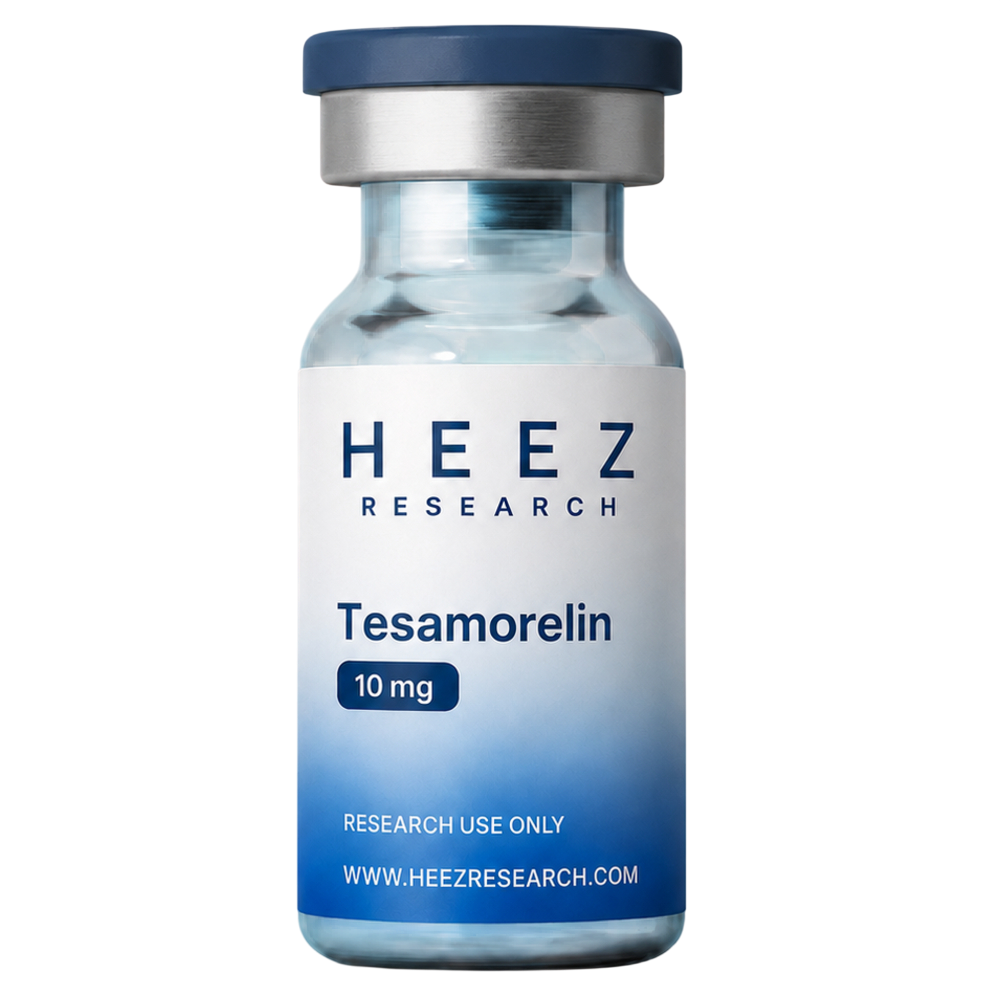
Tesamorelin is available at HEEZ Research
This calculator performs arithmetic on the numbers you enter. It is not medical advice, does not tell you what dose to take, and is not a substitute for guidance from a qualified clinician.
Tesamorelin is supplied as lyophilized powder and must be reconstituted with a liquid before it can be measured. This reference explains how to convert a tesamorelin vial and target dose into the exact number of units to draw on a U-100 insulin syringe. It is written for research purposes only and is not medical advice.
What the calculator does
The peptide reconstitution calculator handles the reconstitution math in two directions:
- Forward mode — enter vial size, water volume, and target dose → it returns the syringe units to draw.
- Reverse mode — enter vial size, target dose, and desired syringe units → it tells you how much water to add.
Both modes work from the same formula: concentration equals mass divided by volume, and dose in units equals dose in volume times 100 (on a U-100 syringe).
Common tesamorelin vial sizes
Research vials are typically supplied in:
- 10 mg
- 20 mg
- 30 mg
The calculator supports any vial size. These three are the most frequently seen for tesamorelin.
Typical research concentration
A common reconstitution setup for tesamorelin scales the water to the vial size at 1 mL per 10 mg, which holds the concentration at a constant 10 mg/mL no matter which vial you're working from:
| Vial size | Water added | Concentration |
|---|---|---|
| 10 mg | 1 mL | 10 mg/mL |
| 20 mg | 2 mL | 10 mg/mL |
| 30 mg | 3 mL | 10 mg/mL |
Because the ratio is fixed, the units for a given dose don't change with vial size — only the number of full doses the vial holds changes.
| Target dose | Units at 10 mg/mL |
|---|---|
| 0.5 mg | 5 units |
| 1 mg | 10 units |
| 2 mg | 20 units |
A 1 mg dose landing on an exact 10-unit mark is the reason 10 mg/mL is the common reference concentration — it's easy to read accurately on any U-100 syringe.
The math
Step 1: Calculate concentration
Concentration = vial mass ÷ water volume
- 10 mg vial + 1 mL water = 10 mg/mL
- 20 mg vial + 2 mL water = 10 mg/mL
- 30 mg vial + 3 mL water = 10 mg/mL
Step 2: Convert dose to volume
Volume (mL) = dose (mg) ÷ concentration (mg/mL)
Example: 1 mg dose at 10 mg/mL concentration = 1 ÷ 10 = 0.1 mL
Step 3: Convert volume to syringe units
On a U-100 insulin syringe, 1 mL = 100 units, so:
Units = volume (mL) × 100
Example: 0.1 mL × 100 = 10 units
The calculator performs these three steps instantly for any vial, water, and dose combination you enter.
Reconstitution process
- Gather supplies — the tesamorelin vial, bacteriostatic water, U-100 insulin syringes, alcohol swabs.
- Swab both vial stoppers with alcohol.
- Draw the calculated water volume (e.g. 1 mL for a 10 mg vial).
- Inject slowly down the inside wall of the vial, not directly onto the powder.
- Swirl gently — do not shake. Let it dissolve completely.
- Verify the concentration matches what you entered in the calculator.
For a detailed walkthrough, see How to Reconstitute Peptides.
Storage
Reconstituted peptide vials are generally stored refrigerated and protected from light. Unreconstituted lyophilized powder is stable at room temperature until the expiration date on the vial. Track the reconstitution date so you know how long a given vial has been mixed.
Why the ratio matters
Some peptides are reconstituted with a fixed water volume regardless of vial size, which means concentration — and therefore units per dose — shifts with vial size. Tesamorelin's common reference setup does the opposite: water scales with mass so the concentration, and the units for any given dose, stay the same across vial sizes:
1 mg dose, any vial size, at the 1 mL per 10 mg ratio:
| Vial size | Water added | Concentration | Units for a 1 mg dose |
|---|---|---|---|
| 10 mg | 1 mL | 10 mg/mL | 10 units |
| 20 mg | 2 mL | 10 mg/mL | 10 units |
| 30 mg | 3 mL | 10 mg/mL | 10 units |
If you'd rather use a different water volume — a bigger vial with less water for a more concentrated draw, for instance — the calculator's reverse mode will show you the resulting units for any combination.
Common mistakes
- Confusing mg and mcg. Tesamorelin vials and doses are generally described in milligrams (mg), not micrograms (mcg). Double-check your units before drawing.
- Shaking the vial. Swirl gently instead — shaking can degrade the peptide.
- Not scaling the water to the vial size. Using the same water volume across a 10 mg and a 30 mg vial produces three different concentrations. Recalculate for each vial size rather than reusing a number from memory.
- Using a non-U-100 syringe. The calculator assumes a standard U-100 insulin syringe (100 units = 1 mL). If your syringe is marked differently, the unit conversion will not match.
Use the calculator
Enter your tesamorelin vial size, bacteriostatic water volume, and target dose into the peptide calculator to see the exact syringe units. Reverse mode also works — enter your target dose and the units you want to draw, and it tells you how much water to add.
For related math, see the GHK-Cu reconstitution calculator guide, the CJC-1295 & Ipamorelin dosage calculator guide, or the general how to reconstitute peptides walkthrough. The calculator handles the math. This guide explains what the numbers mean and where they come from.
Frequently Asked Questions
- How much bacteriostatic water do I add to a tesamorelin vial?
- A common research setup uses 1 mL of bacteriostatic water for every 10 mg of tesamorelin, which keeps the concentration at 10 mg/mL regardless of vial size. A 10 mg vial gets 1 mL, a 20 mg vial gets 2 mL, and a 30 mg vial gets 3 mL. Use the calculator to confirm the units for your exact vial and dose.
- What concentration should I reconstitute tesamorelin to?
- 10 mg/mL is the standard reference concentration because it lands a 1 mg dose on an exact 10-unit mark on a U-100 insulin syringe. Scaling the water to the vial size (1 mL per 10 mg) keeps that concentration constant across the 10 mg, 20 mg, and 30 mg vial sizes.
- How many units is a 1 mg tesamorelin dose?
- At the standard 10 mg/mL concentration, a 1 mg dose is 10 units on a U-100 insulin syringe. This holds for any vial size, as long as the water volume was scaled to keep the concentration at 10 mg/mL.
Ready to calculate? Use the free peptide reconstitution calculator →