KLOW Peptide Blend Calculator: Vial to Syringe Units
By PeptCalc Research — Medically reviewed by David Mansour, MD — Last reviewed July 18, 2026
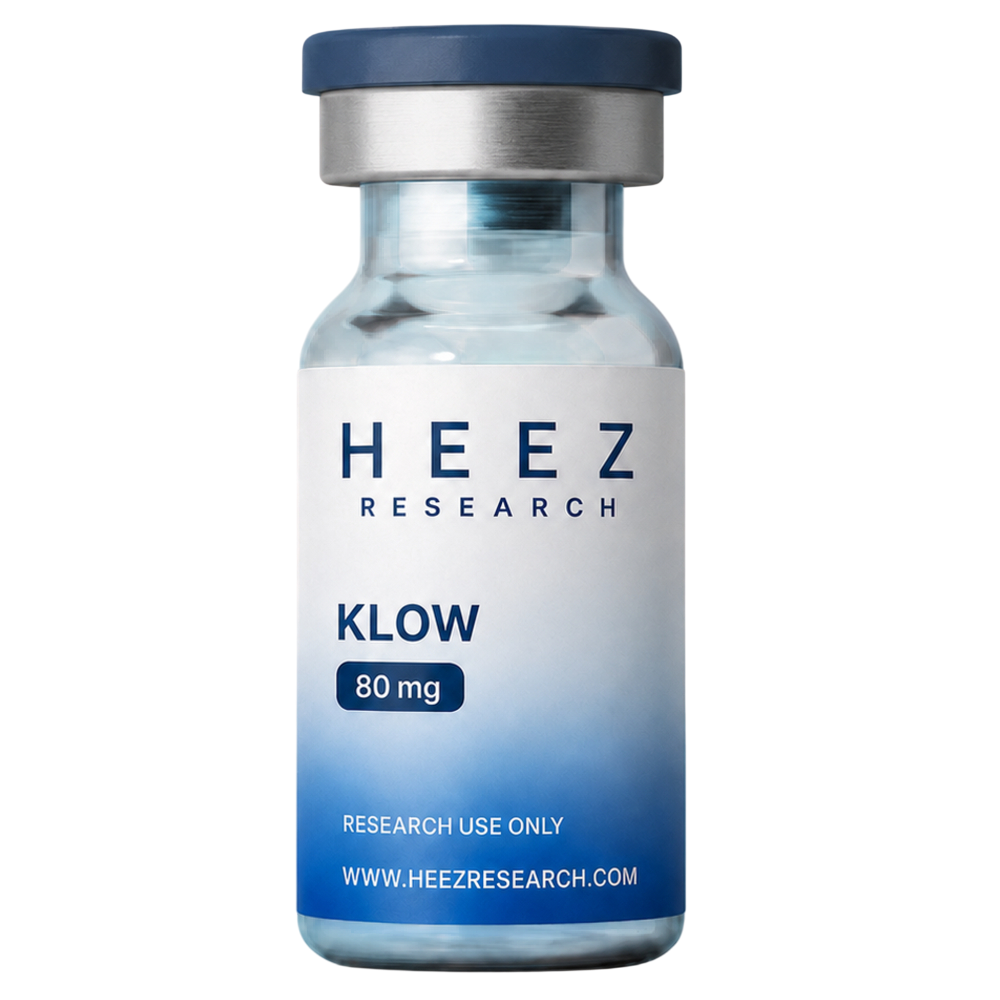
KLOW is available at HEEZ Research
This calculator performs arithmetic on the numbers you enter. It is not medical advice, does not tell you what dose to take, and is not a substitute for guidance from a qualified clinician.
A KLOW peptide blend calculator takes a vial's total mg, the bacteriostatic water added, and a target dose, and returns the exact syringe units to draw. Because KLOW ships as GHK-Cu, KPV, BPC-157, and TB-500 premixed into one vial, the calculator works from the combined total mg rather than any single peptide's share. This guide walks through entering a KLOW vial into the peptide calculator and reading the result. It is a research reference, not medical advice.
What the calculator needs from you
The KLOW peptide blend calculator asks for the same three inputs as any reconstitution calculator on this site:
- Vial total mg — the combined mass of GHK-Cu, KPV, BPC-157, and TB-500 printed on the vial label, not any single component's share.
- Water volume — how much bacteriostatic water you added during reconstitution.
- Target dose — the total mg you want to draw in a single syringe.
From those three numbers, it computes concentration, converts your target dose into a volume in mL, and converts that volume into units on a U-100 insulin syringe, where 1 mL equals 100 units. Because a premixed vial can only be drawn as a single solution, the calculator returns one unit reading for the whole blend rather than four separate figures.
Forward mode vs. reverse mode
The calculator runs in two directions, and which one you use depends on what you already know:
- Forward mode — you already know the vial's total mg and the water you added; you enter a target dose and get back the units to draw. Use this once a vial is reconstituted.
- Reverse mode — you know the vial's total mg and target dose but want the draw to land on a clean, easy-to-read unit mark; you enter that target unit count and the calculator solves for the water volume that gets you there. Use this before adding water, while the volume is still your choice.
Both modes lean on the same relationship: concentration equals total mg divided by water volume, and units equal volume in mL multiplied by 100. Reverse mode just solves that equation for water instead of for units.
Your vial may not match the example
KLOW vials are commonly supplied at a 50 mg GHK-Cu / 10 mg KPV / 10 mg BPC-157 / 10 mg TB-500 split, for 80 mg total — a 5:1:1:1 ratio. That's the figure this guide's examples use, but the calculator itself doesn't assume it. If your vial's label lists a different total mg, enter that number directly; the underlying math is unchanged, only the resulting concentration shifts. Two KLOW vials with different totals, reconstituted in the same water volume, will not land on the same units for the same target dose, so work from your own vial's label rather than a number from a guide.
Worked example
Take an 80 mg KLOW vial (50 mg GHK-Cu, 10 mg KPV, 10 mg BPC-157, 10 mg TB-500) reconstituted with 3 mL of bacteriostatic water.
Step 1 — concentration. 80 mg ÷ 3 mL ≈ 26.7 mg/mL.
Step 2 — dose to volume. For a 2 mg target dose: 2 mg ÷ 26.7 mg/mL = 0.075 mL.
Step 3 — volume to units. 0.075 mL × 100 = 7.5 units, which the calculator displays on a U-100 syringe.
Enter 80 (vial mg), 3 (water mL), and 2 (target dose mg) into the peptide dosage calculator and it returns that same 7.5-unit figure directly, without manual rounding at each step.
Dose chart for an 80 mg / 3 mL vial
| Target total dose | Volume | Units (U-100) |
|---|---|---|
| 1 mg | 0.0375 mL | 3.75 units |
| 2 mg | 0.075 mL | 7.5 units |
| 3 mg | 0.1125 mL | 11.25 units |
| 5 mg | 0.1875 mL | 18.75 units |
This chart holds only for an 80 mg vial reconstituted with 3 mL of water. Change either number and every row shifts — that's why the calculator, not a static chart, is the reliable way to check a dose against your actual vial.
Using reverse mode to land on a clean number
Fractional units like 7.5 are harder to draw precisely on some syringes than a whole number. Reverse mode fixes that before you add water. Using the same 80 mg vial and a 2 mg target dose, set reverse mode's target to 10 units instead of accepting whatever 3 mL produces:
10 units = 0.10 mL, so the required concentration is 2 mg ÷ 0.10 mL = 20 mg/mL. Water volume = 80 mg ÷ 20 mg/mL = 4 mL.
Reconstituting that same 80 mg vial with 4 mL instead of 3 mL puts a 2 mg dose exactly at 10 units — a cleaner mark on most U-100 syringes than 7.5.
Common calculator input mistakes
- Entering one component's mg instead of the vial total. Typing "50" for an 80 mg vial because that's the GHK-Cu share produces a concentration that doesn't match the actual solution in the vial.
- Reusing another guide's water volume. The 3 mL figure here applies to an 80 mg vial; a different vial total needs its own water volume to reach the same concentration.
- Forgetting to re-enter numbers after reverse mode. Once reverse mode returns a water volume, that becomes the new fixed water amount for that vial — later forward-mode doses should use it, not the original figure you started from.
- Mixing up mg and mcg. The calculator works in mg; since 1 mg equals 1000 mcg, a target entered in the wrong unit is off by a factor of 1000.
- Confusing KLOW's total with GLOW's. GLOW is a three-peptide, 70 mg blend without KPV; KLOW adds KPV for an 80 mg total. The same 3 mL water volume produces a different concentration in each.
Evidence level
GHK-Cu, KPV, BPC-157, and TB-500 are each studied in preclinical research, largely animal models and in-vitro work, rather than large controlled human trials. None of the four is FDA-approved for human use, and combining them into a blend doesn't change that evidence picture for any individual component. Treat a KLOW blend as a research compound, not a proven human therapeutic.
Related
The KLOW peptide blend calculator above handles the unit math directly. For the component-by-component ratio behind a KLOW dose, see the KLOW peptide blend dosage guide. For a vial-to-unit reference table at the standard 80 mg size, see the KLOW peptide dosage chart. Or enter your own vial's numbers directly into the free peptide calculator to get an exact unit reading in either mode.
Frequently Asked Questions
- What does the KLOW peptide blend calculator need as input?
- Three numbers: the vial's total mg (GHK-Cu, KPV, BPC-157, and TB-500 combined), the bacteriostatic water volume you added, and the target dose you want to draw. The calculator returns the syringe units for that dose.
- Does the calculator split a KLOW dose into its four components separately?
- No. It works from the vial's combined total mg and returns one unit reading for the full draw. The GHK-Cu, KPV, BPC-157, and TB-500 breakdown by ratio is covered in the KLOW peptide blend dosage guide, not in the unit calculation itself.
- My KLOW vial isn't 80 mg. Can I still use the calculator?
- Yes. Enter your vial's actual total mg and the water volume you used — the calculator doesn't assume a fixed vial size. The 80 mg (50/10/10/10) example in this guide is illustrative, not the only ratio a KLOW vial ships at.
- How do I get a rounder unit reading for a KLOW blend dose?
- Use reverse mode. Enter the vial's total mg and your target dose, set the unit mark you want to land on, and the calculator solves for the water volume that gets you there instead of the other way around.
Ready to calculate? Use the free peptide reconstitution calculator →