KLOW Peptide Blend Dosage Guide: Reconstitution & Units
By PeptCalc Research — Medically reviewed by David Mansour, MD — Last reviewed July 11, 2026
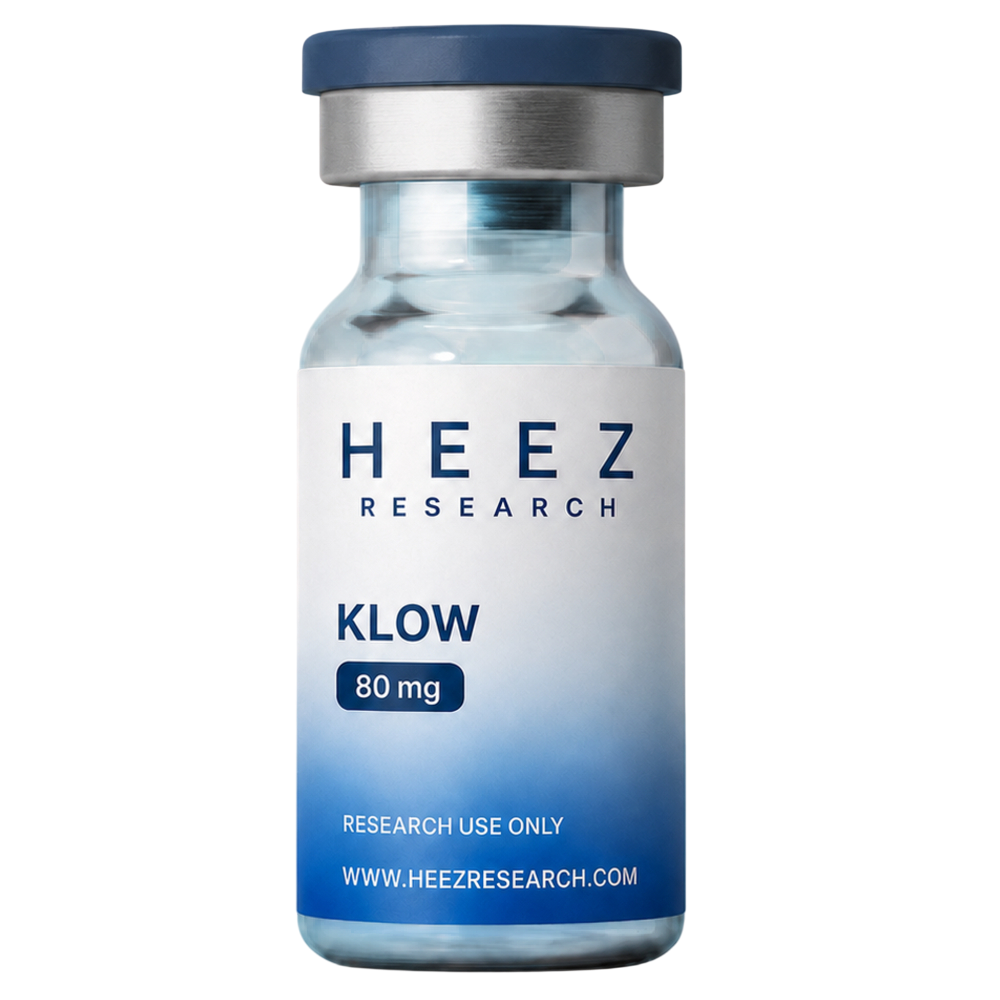
KLOW is available at HEEZ Research
This calculator performs arithmetic on the numbers you enter. It is not medical advice, does not tell you what dose to take, and is not a substitute for guidance from a qualified clinician.
KLOW is a common name for a research peptide blend that combines GHK-Cu, KPV, BPC-157, and TB-500 in a single vial. Because the four peptides ship premixed, a KLOW peptide blend dosage guide has to account for one extra step that single-peptide guides don't: the vial's total milligram count is split across four compounds in a fixed ratio, and that ratio carries through every draw. This is a research reference for that math, not medical advice.
What's in a KLOW peptide blend
A KLOW vial is typically supplied as lyophilized powder containing four peptides at fixed amounts:
- GHK-Cu — 50 mg
- KPV — 10 mg
- BPC-157 — 10 mg
- TB-500 — 10 mg
That's 80 mg of total peptide content per vial, in a 5:1:1:1 ratio. Reconstitution dissolves all four into a single solution — there's no way to draw one component without the other three, since they're mixed together before the water goes in.
Typical reconstitution setup
A common research setup for KLOW keeps the water volume fixed regardless of small variations in vial content, similar to how the related GLOW blend is often reconstituted:
| Vial content | Water added | Concentration |
|---|---|---|
| 80 mg (50/10/10/10 KLOW) | 3 mL | ≈26.7 mg/mL |
More water lowers the concentration and produces a larger, easier-to-read draw. Less water raises the concentration and shrinks the draw. The ratio between GHK-Cu, KPV, BPC-157, and TB-500 stays 5:1:1:1 no matter how much water you add — water changes concentration, not composition.
The math
Step 1: Calculate total concentration
Concentration = total vial mass ÷ water volume
80 mg ÷ 3 mL ≈ 26.7 mg/mL
Step 2: Convert dose to volume
Volume (mL) = target dose (mg) ÷ concentration (mg/mL)
Example: 2 mg dose ÷ 26.7 mg/mL ≈ 0.075 mL
Step 3: Convert volume to syringe units
On a U-100 insulin syringe, 1 mL equals 100 units, so:
Units = volume (mL) × 100
Example: 0.075 mL × 100 = 7.5 units
Worked example
Take an 80 mg KLOW vial (50 mg GHK-Cu, 10 mg KPV, 10 mg BPC-157, 10 mg TB-500) reconstituted with 3 mL of bacteriostatic water, for a concentration of about 26.7 mg/mL.
A 2 mg total blend dose comes out to 7.5 units on a U-100 syringe. Because the vial holds the four peptides at a 5:1:1:1 ratio, that same 2 mg draw breaks down to:
- GHK-Cu: 2 mg × (50 ÷ 80) = 1.25 mg
- KPV: 2 mg × (10 ÷ 80) = 0.25 mg
- BPC-157: 2 mg × (10 ÷ 80) = 0.25 mg
- TB-500: 2 mg × (10 ÷ 80) = 0.25 mg
Those four figures add back up to the 2 mg total dose. The ratio holds at any dose size — doubling the total dose to 4 mg doubles each component's share in the same proportion.
Dose chart
| Target total dose | Volume drawn | Units (U-100) |
|---|---|---|
| 1 mg | 0.0375 mL | 3.75 units |
| 2 mg | 0.075 mL | 7.5 units |
| 2.5 mg | 0.094 mL | 9.4 units |
| 4 mg | 0.15 mL | 15 units |
Rather than working through this by hand, enter the vial's total mg, water volume, and target dose into the peptide reconstitution calculator and it returns the exact units, including a reverse mode that solves for the water volume needed to land a dose on a cleaner mark.
KLOW versus GLOW
KLOW and GLOW share three of their four components. GLOW is GHK-Cu, BPC-157, and TB-500 at 50/10/10 mg (70 mg total, a 5:1:1 ratio). KLOW keeps that same base and adds 10 mg of KPV, bringing the vial to 80 mg total at a 5:1:1:1 ratio. The extra peptide changes the total mass the water has to dissolve, which is why the two blends land at different concentrations from the same 3 mL water volume — 23.3 mg/mL for GLOW versus 26.7 mg/mL for KLOW. Mixing up which blend a given vial is will throw off every dose calculated from it, so treat the two as separate entries even though the reconstitution steps look identical.
Why the fixed ratio matters
With a single-peptide vial, the only thing that changes your draw is the water you add. With a blend, the manufacturer has already fixed the ratio between compounds before you ever add water — the 50/10/10/10 split in a KLOW vial isn't something the calculator or the reconstitution step can adjust. If a research protocol calls for a different ratio between GHK-Cu, KPV, BPC-157, and TB-500 than the vial provides, that's a reason to reconstitute separate single-peptide vials instead of a pre-mixed blend, not to try to compensate with water volume. Water volume only ever changes concentration, never the underlying ratio.
This is also where dosing errors tend to happen with any peptide, blended or not: not at the injection, but at the reconstitution step, where the water volume added sets the concentration for every draw that follows. Getting that one number wrong carries through to every subsequent dose.
Evidence level
GHK-Cu, KPV, BPC-157, and TB-500 are each individually studied in preclinical research — largely animal models and in-vitro work — rather than large controlled human trials. None of the four is FDA-approved for human use, and combining them into a blend doesn't change that evidence picture for any individual component. Treat KLOW, like its component peptides, as a research compound rather than a proven human therapeutic.
Common mistakes
- Treating the blend's total mg as if it were one peptide's dose. A "2 mg KLOW dose" is 2 mg of combined peptide split 5:1:1:1, not 2 mg of each component.
- Confusing KLOW's concentration with GLOW's. The two blends use different total vial mg, so the same 3 mL water volume gives a different mg/mL in each.
- Shaking instead of swirling. Inject the bacteriostatic water down the inside wall of the vial and swirl gently to dissolve.
- Losing track of which vial is which concentration. If you reconstitute a KLOW vial alongside single-peptide or GLOW vials, label each one before they end up in the same fridge.
Related
For the reconstitution basics that apply to any peptide vial, see how to reconstitute peptides. For the closely related three-peptide blend, see the GLOW peptide blend dosage guide. Or skip straight to the free peptide calculator and enter your KLOW vial's total mg, water volume, and target dose directly.
Frequently Asked Questions
- What's in a KLOW peptide blend vial?
- A KLOW blend vial commonly combines GHK-Cu, KPV, BPC-157, and TB-500 in a single lyophilized vial, often at a 50 mg / 10 mg / 10 mg / 10 mg ratio (80 mg total). Reconstituting the vial dissolves all four into one solution, so every draw contains all four in that fixed ratio.
- How much bacteriostatic water goes into a KLOW blend vial?
- A common research setup uses 3 mL of bacteriostatic water for an 80 mg (50/10/10/10) KLOW vial, which works out to about 26.7 mg/mL. Use the calculator to see the units for your exact vial and water volume.
- How many units is a 2 mg KLOW blend dose?
- At 3 mL water in an 80 mg vial (about 26.7 mg/mL), a 2 mg total dose is about 7.5 units on a U-100 insulin syringe. A 4 mg dose from the same vial is about 15 units.
- How is KLOW different from GLOW?
- GLOW is GHK-Cu, BPC-157, and TB-500 in a 5:1:1 ratio (70 mg total). KLOW adds a fourth peptide, KPV, at the same 10 mg share as BPC-157 and TB-500, for an 80 mg vial in a 5:1:1:1 ratio. The extra 10 mg of KPV is the only difference in the math.
Ready to calculate? Use the free peptide reconstitution calculator →