Tesamorelin vs Sermorelin: GHRH Analogs Compared
By PeptCalc Research — Medically reviewed by David Mansour, MD — Last reviewed July 25, 2026
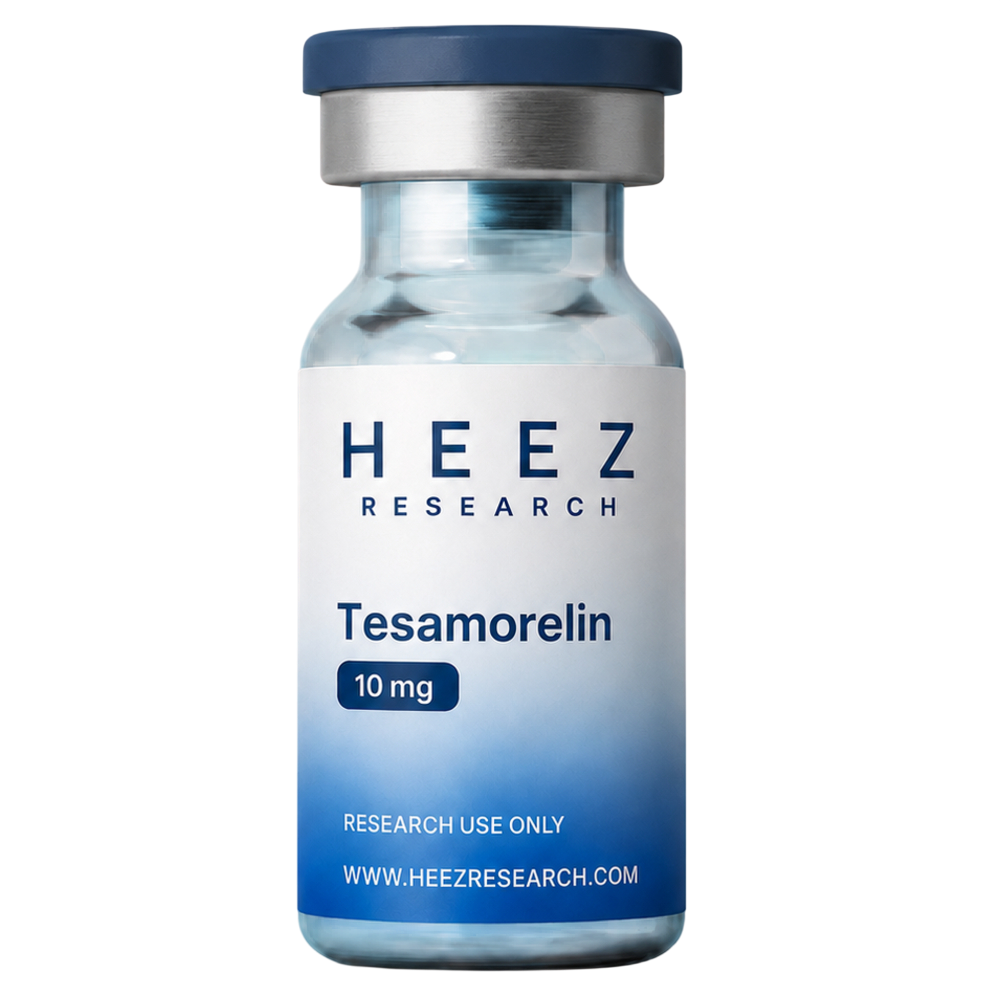
Tesamorelin is available at HEEZ Research
This calculator performs arithmetic on the numbers you enter. It is not medical advice, does not tell you what dose to take, and is not a substitute for guidance from a qualified clinician.
Tesamorelin and sermorelin both show up in research discussions of growth hormone-releasing hormone (GHRH) analogs, and the overlap in name and mechanism makes them easy to lump together. Tesamorelin vs sermorelin is really a comparison between a stabilized, fully-approved molecule and a shorter, unmodified fragment with a very different regulatory history. This reference lines up what's different between tesamorelin and sermorelin, and what stays identical in the reconstitution math. It is written for research and educational purposes only and is not medical advice.
What separates tesamorelin and sermorelin
Both peptides act on the GHRH receptor, which is why they're compared to each other rather than to a ghrelin-receptor compound like ipamorelin. The molecules themselves are not the same size. Tesamorelin is a stabilized analog of the full 44-amino acid GHRH molecule, with an added modification that slows its breakdown in circulation. Sermorelin is shorter: it corresponds to GRF(1-29), the first 29 amino acids of natural human GHRH, and carries none of tesamorelin's stabilizing changes.
That structural gap has a practical consequence. Unmodified GHRH fragments clear from the body quickly, and sermorelin is no exception — research literature commonly describes its circulating activity in terms of minutes rather than hours. Tesamorelin's stabilizing modification exists specifically to resist that fast clearance. Neither peptide's reconstitution or storage handling changes because of this difference — both arrive as lyophilized powder and dissolve the same way in bacteriostatic water — but it's the reason research protocols involving the two compounds are rarely built around the same dosing interval.
Regulatory and research status
This is where tesamorelin and sermorelin diverge the most. Tesamorelin has a current FDA-approved pharmaceutical formulation, marketed as Egrifta and Egrifta SV, indicated for reducing excess abdominal fat in adults with HIV-associated lipodystrophy. That approval reflects completed human trials for that specific indication, and the labeling is publicly available through DailyMed.
Sermorelin's history is different. It was previously sold in the United States under an FDA-approved brand name, Geref, for evaluating growth hormone secretion. That commercial product was later discontinued by its manufacturer. Sermorelin used in research settings today is not sold as an FDA-approved commercial drug product. Neither compound's regulatory history extends beyond what's described here — tesamorelin's approval is specific to its one cleared indication, and sermorelin's earlier approval doesn't carry over to how it's supplied or discussed now.
Vial formats and typical concentrations
Both peptides reach researchers as lyophilized powder in single-peptide vials. Reference points that are common because they land typical research doses on clean, easy-to-read syringe marks:
| Peptide | Common vial size | Reference water volume | Concentration |
|---|---|---|---|
| Tesamorelin | 10 mg | 2 mL | 5 mg/mL |
| Sermorelin | 5 mg | 2 mL | 2.5 mg/mL |
These are reference points, not requirements. The peptide calculator recalculates concentration and syringe units for any vial size and water volume you enter, for either compound.
Worked example: same formula, different molecules
The formula is identical regardless of which GHRH fragment is in the vial: concentration equals mass divided by water volume, and syringe units equal that volume in mL multiplied by 100 on a U-100 insulin syringe.
Tesamorelin. A 10 mg vial with 2 mL of bacteriostatic water is 10 ÷ 2 = 5 mg/mL. A 1 mg dose is 1 ÷ 5 = 0.2 mL, or 0.2 × 100 = 20 units.
Sermorelin. A 5 mg vial with 2 mL of bacteriostatic water is 5 ÷ 2 = 2.5 mg/mL. A 0.5 mg dose is 0.5 ÷ 2.5 = 0.2 mL, or 0.2 × 100 = 20 units.
Both examples land on the same draw volume and the same unit reading, but only because these particular numbers were chosen for the comparison. Change the vial size, the water volume, or the target dose for either compound, and the units change independently — recalculate rather than assuming the two track each other.
Why one calculator covers both
The step where a research dose most often goes wrong isn't the injection — it's the reconstitution math before it. A U-100 insulin syringe always reads 100 units per mL, so the amount of active peptide represented by each unit depends entirely on how much water went into the vial. That holds whether the vial contains tesamorelin or sermorelin. Get the water volume wrong and every draw that follows inherits the same error, regardless of which GHRH fragment is involved. That's why a single free peptide calculator built on the mass-divided-by-volume formula covers both compounds without any peptide-specific adjustment. For the general mixing walkthrough, see how to reconstitute peptides.
Where the comparison breaks down
The reconstitution math is identical for tesamorelin and sermorelin; the molecules and their regulatory histories are not. Tesamorelin's approved dosing schedule for its cleared indication came out of completed human trials specific to that molecule and that use — it says nothing about sermorelin, which has no current FDA-approved formulation. And because unmodified GHRH fragments clear quickly, sermorelin's shorter activity window is a structural property of the molecule itself, not a dosing preference that carries over from tesamorelin. Assuming the two are interchangeable because they share a receptor, or assuming sermorelin inherits any part of tesamorelin's current approval, are the two most common mix-ups in how this comparison gets discussed.
Common mistakes
- Assuming sermorelin shares tesamorelin's current FDA approval. It doesn't. Tesamorelin's approval covers one specific indication for the tesamorelin molecule; sermorelin has no currently marketed FDA-approved formulation.
- Treating the two as equivalent because they share a receptor. Acting on the same GHRH receptor doesn't mean two molecules clear from the body at the same rate or are discussed the same way in the research literature.
- Confusing mg and mcg. Tesamorelin and sermorelin doses are described in milligrams or micrograms depending on the source. 1 mg equals 1,000 mcg, and misreading one for the other produces a 1,000x error.
- Shaking the vial. Swirl gently instead — shaking can degrade the peptide.
- Reusing a water volume across vial sizes. A water volume that gives 5 mg/mL for a 10 mg tesamorelin vial gives a different concentration on a 20 mg or 30 mg vial. Recalculate rather than reusing a number from memory.
- Assuming a dosing frequency from one compound applies to the other. Sermorelin's fast clearance and tesamorelin's stabilizing modification are structurally different properties. Neither interval transfers to the other compound.
Related
For the tesamorelin-specific reconstitution walkthrough, see the tesamorelin reconstitution calculator guide. For a comparison against another GHRH analog with an added stabilizing modification, see tesamorelin vs CJC-1295. Or enter your own vial size, water volume, and target dose into the peptide reconstitution calculator to see the exact syringe units for either compound.
Frequently Asked Questions
- Are tesamorelin and sermorelin the same peptide?
- No. Both are analogs of growth hormone-releasing hormone (GHRH) and act on the same GHRH receptor, but they are built from different sequences. Tesamorelin is a stabilized analog of the full 44-amino acid GHRH molecule. Sermorelin is the shorter GRF(1-29) fragment, the first 29 amino acids of natural GHRH, without tesamorelin's added stabilizing modification.
- Is tesamorelin or sermorelin FDA-approved?
- Tesamorelin has a current FDA-approved formulation, marketed as Egrifta and Egrifta SV, indicated for reducing excess abdominal fat in adults with HIV-associated lipodystrophy, per its labeling on DailyMed. Sermorelin was previously sold under an FDA-approved brand, Geref, but that commercial product was discontinued by its manufacturer, and sermorelin used in research today is not sold as an FDA-approved drug product.
- Why is sermorelin dosed more often than tesamorelin in research protocols?
- Sermorelin is an unmodified GHRH fragment, and unmodified GHRH clears from circulation quickly. Tesamorelin carries a stabilizing modification specifically designed to resist that breakdown. That structural difference, not a difference in goal, is why research protocols built around sermorelin tend to use shorter, more frequent dosing intervals than tesamorelin protocols.
- Does the same calculator work for both tesamorelin and sermorelin?
- Yes. Concentration equals vial mass divided by water volume, and syringe units equal that volume in mL times 100 on a U-100 insulin syringe. That formula doesn't change based on which GHRH fragment is in the vial.
Ready to calculate? Use the free peptide reconstitution calculator →