MT-1 vs MT-2: Melanotan Dosage Compared
By PeptCalc Research — Medically reviewed by David Mansour, MD — Last reviewed August 19, 2026
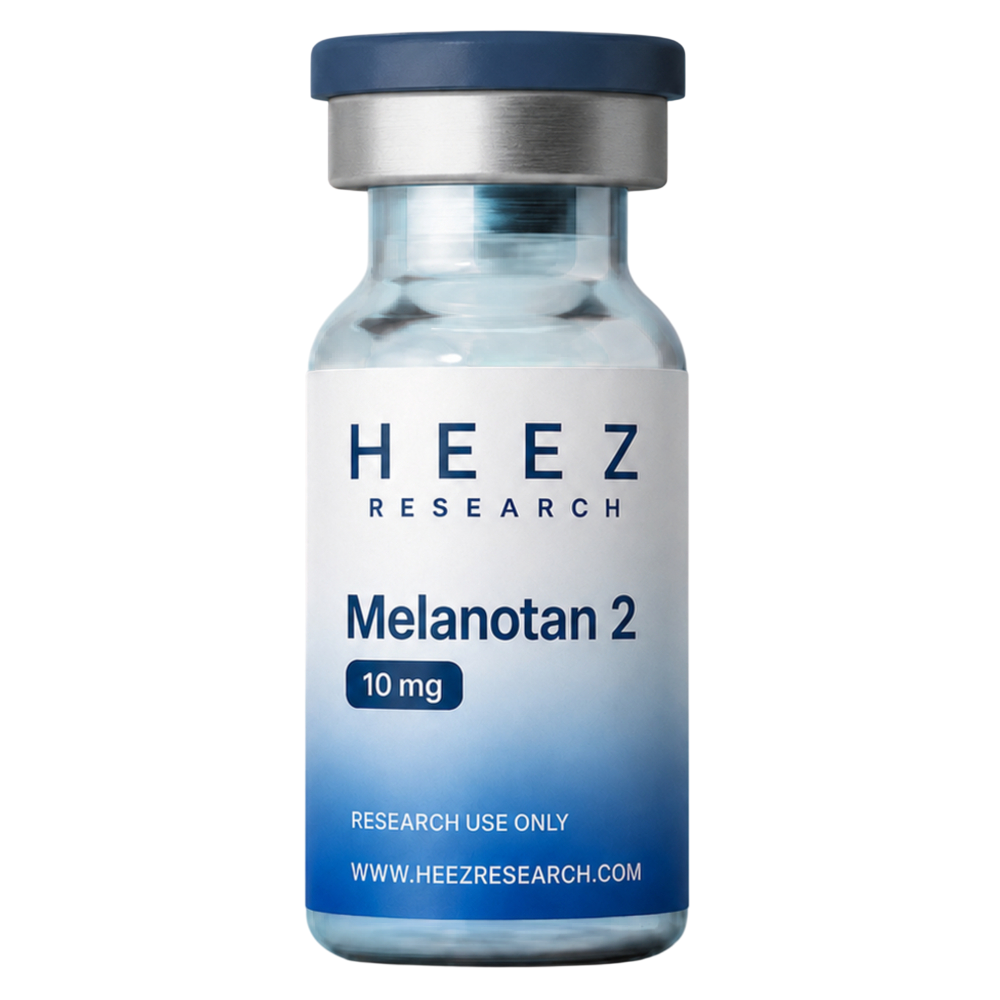
Melanotan 2 is available at HEEZ Research
This calculator performs arithmetic on the numbers you enter. It is not medical advice, does not tell you what dose to take, and is not a substitute for guidance from a qualified clinician.
MT-1 vs MT-2 melanotan dosage compared side by side comes up often, since both peptides share a name prefix, a research history, and near-identical packaging, but they are not the same molecule. MT-1 (Melanotan I) is the linear analog of alpha-melanocyte-stimulating hormone; MT-2 (Melanotan II) is the cyclic analog that shows up far more often in research discussion. This reference lines up what separates the two and what stays identical once either vial reaches a syringe. It is written for research and educational purposes only and is not medical advice.
What separates MT-1 and MT-2
Both peptides are synthetic analogs of alpha-melanocyte-stimulating hormone (alpha-MSH), the naturally occurring hormone studied in connection with pigmentation. MT-1 is the linear analog. MT-2 is a cyclic analog built from a different amino acid sequence, which is the structural change most often cited as the reason MT-2 became the more widely referenced of the two compounds. Neither structural difference changes how the vial is prepared: both MT-1 and MT-2 arrive as lyophilized powder that has to be reconstituted with a liquid before it can be measured or drawn into a syringe.
Regulatory status
Neither MT-1 nor MT-2 has an FDA-approved formulation for any use. Both remain unapproved research compounds, and neither should be treated as interchangeable with an approved drug just because it shares a research lineage with one. A related melanocortin peptide, bremelanotide (marketed as PT-141), does carry one narrow FDA approval — but that approval belongs to a distinct molecule, not to MT-1 or MT-2. See the PT-141 vs Melanotan 2 comparison for how that distinction plays out.
Typical vial concentrations
Both peptides reach researchers as lyophilized powder, typically reconstituted in 2 mL of bacteriostatic water for a 10 mg vial — a reference point that keeps microgram-range research doses on readable syringe marks:
| Peptide | Common vial size | Reference water volume | Concentration |
|---|---|---|---|
| MT-1 | 10 mg | 2 mL | 5,000 mcg/mL |
| MT-2 | 10 mg | 2 mL | 5,000 mcg/mL |
These are reference points pulled from how MT-1 and MT-2 vials are most commonly supplied and reconstituted, not requirements. The peptide calculator recalculates concentration and syringe units for any vial size and water volume entered, for either compound.
Worked example: same formula, different unit counts
The formula doesn't change based on which melanotan variant is in the vial: concentration equals mass divided by water volume, and syringe units equal that volume in mL multiplied by 100 on a U-100 syringe.
Shared starting point. A 10 mg vial of either MT-1 or MT-2, reconstituted in 2 mL of bacteriostatic water, works out to 10,000 mcg ÷ 2 mL = 5,000 mcg/mL — 50 mcg per syringe unit, regardless of which one is in the vial.
MT-1. A 1,000 mcg research reference dose from that vial is 1,000 ÷ 50 = 20 units.
MT-2. A 250 mcg research reference dose from the same concentration is 250 ÷ 50 = 5 units.
Both peptides can share an identical 5,000 mcg/mL concentration, since the reconstitution math depends only on vial mass and water volume. The two compounds are commonly referenced at different example dose sizes, though, which is why the two worked examples above land on different unit counts even from the same starting concentration.
Why the water volume matters more than the peptide
The same 1,000 mcg dose can land on very different unit marks depending on how much bacteriostatic water goes into the vial — and that holds whether the vial is labeled MT-1 or MT-2:
1,000 mcg dose from a 10 mg vial:
| Water added | Concentration | Draw volume | Units |
|---|---|---|---|
| 2 mL | 5,000 mcg/mL | 0.2 mL | 20 units |
| 1 mL | 10,000 mcg/mL | 0.1 mL | 10 units |
Neither draw is wrong — the arithmetic is identical either way. Less water gives a smaller, more concentrated draw; more water gives a larger, easier-to-read draw. The same table applies to either compound, because the water volume, not which melanotan variant is in the vial, is what sets the concentration. The peptide dosage calculator works out this table instantly for any vial size, water volume, and target dose.
Why one calculator covers both
The step most likely to introduce an error isn't the injection — it's the reconstitution arithmetic before it. A U-100 insulin syringe always reads 100 units per mL, so how much active peptide each unit represents depends entirely on how much water went into the vial, not on whether the vial holds the linear or cyclic form of alpha-MSH. Get the water volume wrong and every draw that follows carries the same error forward, whichever melanotan variant is involved. That's why a single free peptide dosage calculator built on the mass-divided-by-water-volume formula works for both compounds without any peptide-specific adjustment. For the general mixing walkthrough, see how to reconstitute peptides.
Where the comparison breaks down
The reconstitution math is identical for MT-1 and MT-2; the molecules behind it are not. MT-1 is a linear alpha-MSH analog, and MT-2 is a cyclic analog with a different amino acid sequence — a structural difference, not a labeling variation. Treating the two names as synonyms because they share a research origin and near-identical packaging is the most common mix-up in how this comparison gets discussed. Neither carries FDA approval, so neither inherits any regulatory standing the other lacks.
Common mistakes
- Assuming MT-1 and MT-2 are the same compound. They share a name prefix and a research history, not a structure. MT-1 is linear; MT-2 is cyclic.
- Confusing mg and mcg. Both peptides are commonly dosed in micrograms. 1 mg equals 1,000 mcg, and misreading one for the other produces a tenfold dosing error.
- Shaking the vial. Swirl gently instead — shaking can degrade the peptide.
- Reusing a unit count across a different water volume. A 5,000 mcg/mL concentration only holds for the exact vial size and water volume it was calculated from. Recalculate rather than reusing a number from memory.
Related
For the MT-1-specific numbers, see the MT-1 dosage calculator guide. For the MT-2-specific numbers, see the MT-2 dosage calculator guide. Or enter a vial size, water volume, and target dose into the free peptide calculator to see the exact syringe units for either compound.
Frequently Asked Questions
- Are MT-1 and MT-2 the same peptide?
- No. Both are synthetic analogs of alpha-melanocyte-stimulating hormone, but MT-1 (Melanotan I) is the linear analog and MT-2 (Melanotan II) is a cyclic analog built with a different amino acid sequence. That structural difference is the main reason the two names get treated as interchangeable when they refer to distinct molecules.
- Is MT-1 or MT-2 FDA-approved?
- Neither has an FDA-approved formulation for any use. Both remain unapproved research compounds, regardless of which one a given source discusses.
- Does the same calculator work for both MT-1 and MT-2?
- Yes. Concentration equals vial mass divided by water volume, and syringe units equal that volume in mL times 100 on a U-100 insulin syringe. That formula is identical whether the vial holds MT-1 or MT-2.
- How many units is a 250 mcg dose of either peptide?
- At a 5,000 mcg/mL concentration (a 10 mg vial reconstituted with 2 mL of bacteriostatic water), a 250 mcg research reference dose works out to 5 units on a U-100 syringe for either MT-1 or MT-2, since the concentration and the formula are the same.
Ready to calculate? Use the free peptide reconstitution calculator →