PT-141 vs Melanotan 2: Melanocortin Peptides Compared
By PeptCalc Research — Medically reviewed by David Mansour, MD — Last reviewed August 12, 2026
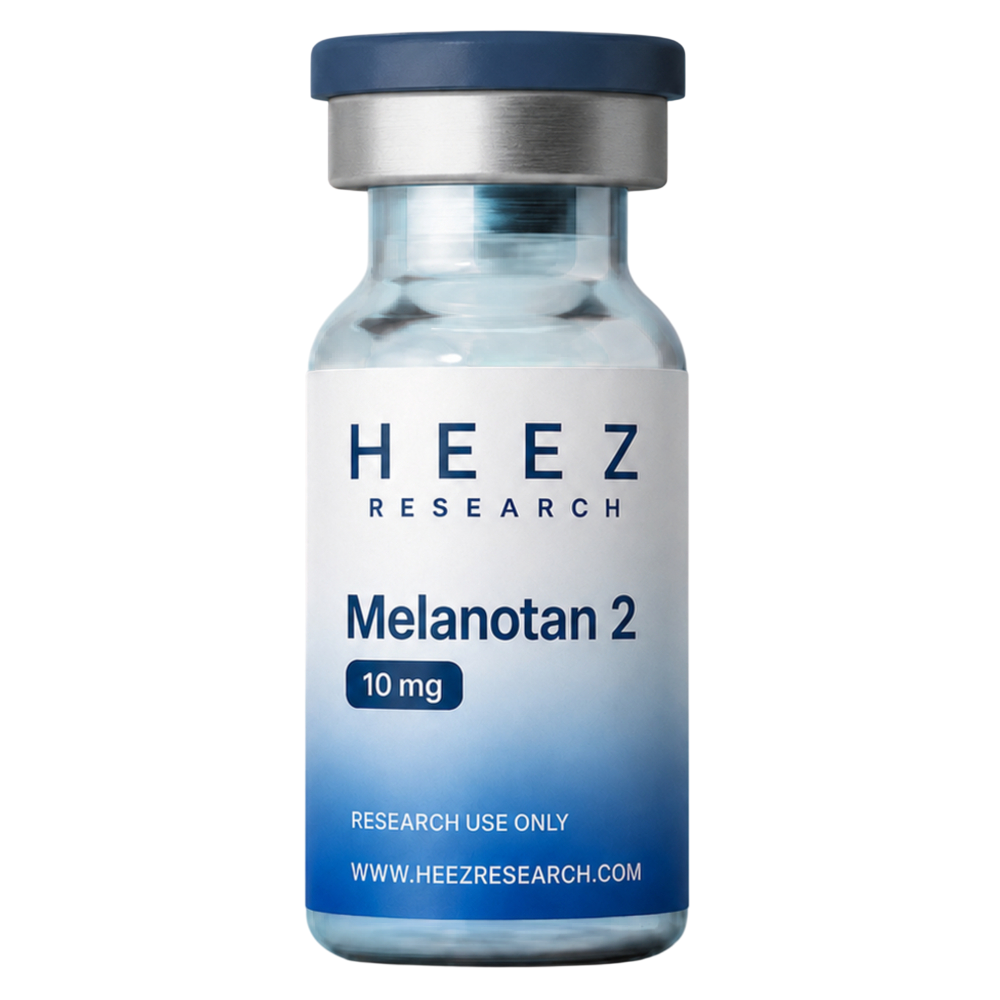
Melanotan 2 is available at HEEZ Research
This calculator performs arithmetic on the numbers you enter. It is not medical advice, does not tell you what dose to take, and is not a substitute for guidance from a qualified clinician.
PT-141 and Melanotan 2 come up together often enough that the two get treated as interchangeable, and the shared research history makes that mix-up understandable. PT-141 vs Melanotan 2 is really a comparison between a molecule with one narrow FDA approval and the broader, unapproved compound it was derived from studying. This reference lines up what separates the two and what stays identical in the reconstitution math. It is written for research and educational purposes only and is not medical advice.
What separates PT-141 and Melanotan 2
Melanotan II is a synthetic analog of alpha-melanocyte-stimulating hormone, studied as a nonselective agonist across melanocortin receptor subtypes, including the MC1 receptor connected to skin pigmentation. PT-141, also known as bremelanotide, was identified as a metabolite of Melanotan II during that early research — a related molecule, not the same one. PT-141 was developed with greater selectivity toward the MC4 receptor, the subtype tied to its later FDA-approved indication. That difference in receptor selectivity is the reason the two compounds ended up studied for different purposes despite sharing a research origin.
Structurally, both arrive at the same physical starting point: lyophilized powder in a sealed vial, reconstituted with bacteriostatic water before use. Nothing about the receptor-selectivity difference changes how either vial is mixed.
Regulatory and research status
This is where PT-141 and Melanotan 2 diverge most. Bremelanotide, the active compound in PT-141, has a current FDA-approved formulation: Vyleesi, a fixed-dose 1.75 mg subcutaneous injection approved in 2019 for acquired, generalized hypoactive sexual desire disorder in premenopausal women, administered as a single dose at least 45 minutes before anticipated sexual activity (FDA prescribing information, via DailyMed). That approval covers one specific branded product at one fixed dose — it does not extend to the lyophilized PT-141 research vials this guide's math applies to, which are a different, non-approved product.
Melanotan II has no FDA-approved formulation for any use. It has never carried the kind of completed human-trial approval pathway that produced Vyleesi. Assuming Melanotan II shares any part of PT-141's regulatory status because the two compounds are related is one of the most common errors in how this comparison gets discussed.
Typical vial concentrations
Both peptides reach researchers as lyophilized powder, typically reconstituted in 2 mL of bacteriostatic water — a reference point chosen because it keeps typical microgram-range research doses on readable syringe marks:
| Peptide | Common vial size | Reference water volume | Concentration |
|---|---|---|---|
| PT-141 | 10 mg | 2 mL | 5,000 mcg/mL |
| Melanotan II | 10 mg | 2 mL | 5,000 mcg/mL |
These are reference points, not requirements. The peptide calculator recalculates concentration and syringe units for any vial size and water volume entered, for either compound.
Worked example: same formula, different doses
The formula doesn't change based on which melanocortin peptide is in the vial: concentration equals mass divided by water volume, and syringe units equal that volume in mL multiplied by 100 on a U-100 syringe.
Shared starting point. A 10 mg vial of either PT-141 or Melanotan II, reconstituted in 2 mL of bacteriostatic water, is 10,000 mcg ÷ 2 mL = 5,000 mcg/mL, which works out to 50 mcg per syringe unit.
PT-141. A 1,000 mcg (1 mg) research reference dose from that vial is 1,000 ÷ 50 = 20 units.
Melanotan II. A 250 mcg research reference dose from the same concentration is 250 ÷ 50 = 5 units.
Both peptides can share an identical concentration, since the reconstitution math only depends on vial mass and water volume — but the two compounds are typically referenced at very different dose sizes in research discussion, which is why their unit counts land far apart even from the same 5,000 mcg/mL vial.
Why one calculator covers both
The step where a research dose most often goes wrong isn't the injection — it's the reconstitution math before it. A U-100 insulin syringe always reads 100 units per mL, so the amount of active peptide represented by each unit depends entirely on how much water went into the vial. That holds whether the vial contains PT-141 or Melanotan II. Get the water volume wrong and every draw that follows inherits the same error, regardless of which melanocortin peptide is involved. That's why a single free peptide calculator built on the mass-divided-by-water-volume formula covers both compounds without any peptide-specific adjustment. For the general mixing walkthrough, see how to reconstitute peptides.
Where the comparison breaks down
The reconstitution math is identical for PT-141 and Melanotan II; the two compounds' receptor selectivity and regulatory histories are not. PT-141's FDA approval covers one fixed-dose product for one specific indication — it says nothing about Melanotan II, which has no approved formulation at all. And because PT-141 was developed for greater MC4-receptor selectivity, it isn't a straightforward substitute for the nonselective activity Melanotan II is studied for. Treating the two as the same compound because one was discovered while studying the other, or assuming Melanotan II inherits any part of PT-141's approval, are the two most common mix-ups in how this comparison gets discussed.
Common mistakes
- Assuming Melanotan II shares PT-141's FDA approval. It doesn't. Vyleesi's approval is specific to the bremelanotide molecule at one fixed dose; Melanotan II has no approved formulation.
- Treating the two as interchangeable because one was derived from studying the other. A shared research origin isn't the same as shared receptor selectivity or a shared indication.
- Confusing mg and mcg. Both peptides are commonly dosed in micrograms. 1 mg equals 1,000 mcg, and misreading one for the other produces a 1,000x error.
- Shaking the vial. Swirl gently instead — shaking can degrade the peptide.
- Reusing a unit count across a different water volume. A 5,000 mcg/mL concentration only holds for the exact vial size and water volume it was calculated from. Recalculate rather than reusing a number from memory.
Related
For the PT-141-specific reconstitution walkthrough, see the PT-141 dosage calculator guide. For the Melanotan II-specific numbers, see the MT-2 dosage calculator. Or enter a vial size, water volume, and target dose into the peptide reconstitution calculator to see the exact syringe units for either compound.
Frequently Asked Questions
- Are PT-141 and Melanotan 2 the same peptide?
- No. PT-141, also called bremelanotide, was identified as a metabolite of Melanotan II during early melanocortin research and is a distinct molecule from it. Melanotan II is a nonselective melanocortin receptor agonist studied mainly in connection with pigmentation. PT-141 was developed with greater selectivity toward the MC4 receptor, the receptor subtype linked to its FDA-approved indication.
- Is PT-141 or Melanotan 2 FDA-approved?
- PT-141 has one FDA-approved formulation: bremelanotide, branded as Vyleesi, approved in 2019 as a fixed-dose 1.75 mg subcutaneous injection for acquired, generalized hypoactive sexual desire disorder in premenopausal women, per its labeling on DailyMed. Melanotan II has no FDA-approved formulation for any use.
- Why are PT-141 and Melanotan 2 research doses both described in micrograms?
- Both peptides are typically dosed at a small fraction of a milligram, so micrograms give a more readable number than a decimal fraction of a milligram. 1 mg equals 1,000 mcg, and the calculator converts between the two automatically.
- Does the same calculator work for both PT-141 and Melanotan 2?
- Yes. Concentration equals vial mass divided by water volume, and syringe units equal that volume in mL times 100 on a U-100 insulin syringe. That formula is identical regardless of which melanocortin peptide is in the vial.
Ready to calculate? Use the free peptide reconstitution calculator →