KLOW Peptide Blend Vial Size: Reconstitution Math
By PeptCalc Research — Medically reviewed by David Mansour, MD — Last reviewed August 8, 2026
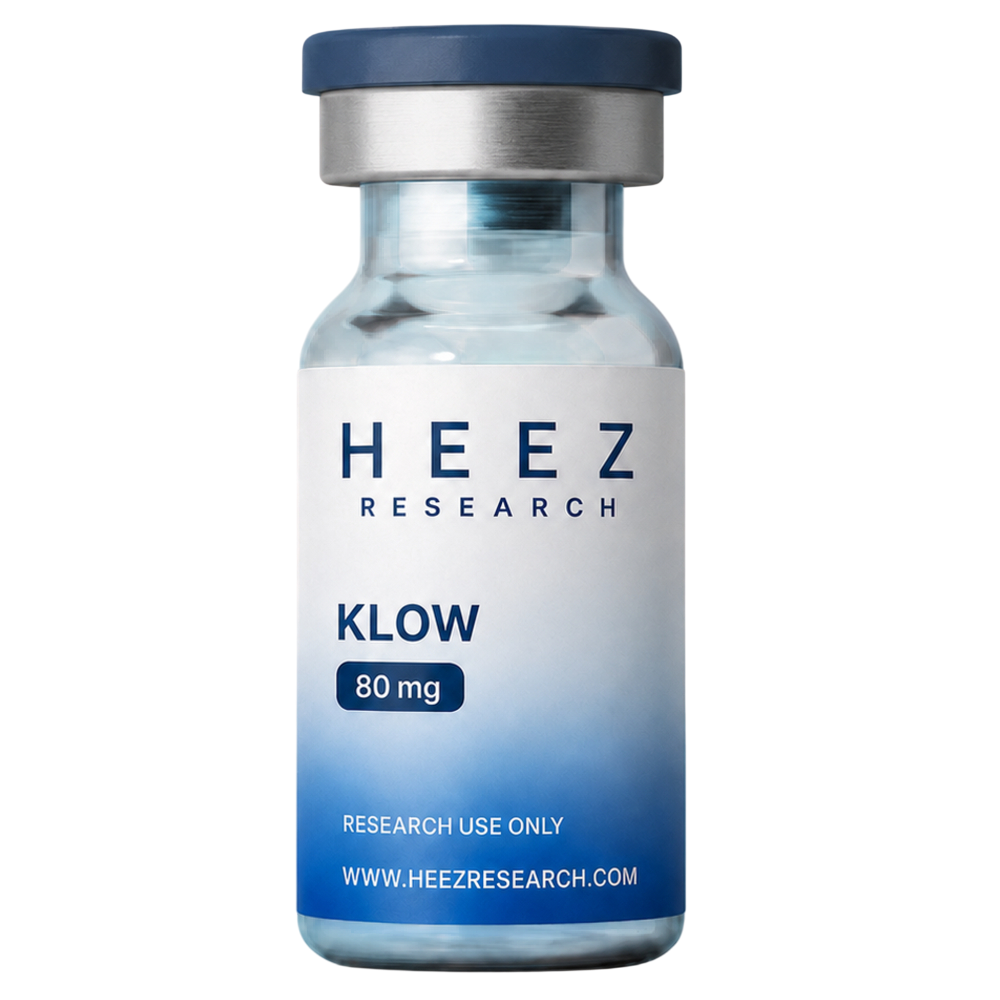
KLOW is available at HEEZ Research
This calculator performs arithmetic on the numbers you enter. It is not medical advice, does not tell you what dose to take, and is not a substitute for guidance from a qualified clinician.
KLOW peptide blend vial size is a supply question, not a draw-math question: how much total GHK-Cu, KPV, BPC-157, and TB-500 does a given vial actually contain, and how far does that stretch across a protocol? Vial size is fixed at manufacture and printed in milligrams on the label, but what it means day to day depends on the target dose and the water volume chosen at reconstitution. This guide separates what vial size does and doesn't determine for a KLOW blend. It is a research reference, not medical advice.
Common KLOW vial sizes
KLOW ships as GHK-Cu, KPV, BPC-157, and TB-500 premixed in one lyophilized vial, and research suppliers commonly offer it at two totals:
| Vial size | Composition (5:1:1:1 ratio) |
|---|---|
| 40 mg | 25 mg GHK-Cu / 5 mg KPV / 5 mg BPC-157 / 5 mg TB-500 |
| 80 mg | 50 mg GHK-Cu / 10 mg KPV / 10 mg BPC-157 / 10 mg TB-500 |
Both sizes hold the same 5:1:1:1 split across the four peptides — a 40 mg vial is simply half of an 80 mg vial's content, not a different formula. Labeling isn't standardized across every supplier, so treat these two figures as common reference points and confirm the actual mg total on your own vial before running any calculation.
Vial size sets total mg, not the size of one draw
The point worth separating out first: vial size determines how many total milligrams of blend you have to work with across the whole vial, not how large any single draw is. A 2 mg dose is a 2 mg dose whether it comes from a 40 mg vial or an 80 mg vial. What changes is how many 2 mg draws the vial can supply before it's empty. That relationship is one division:
Doses per vial = vial mass (mg) ÷ target dose (mg)
Worked example: doses per vial
Compare the two common sizes at a fixed 2 mg target dose:
- 40 mg vial: 40 ÷ 2 = 20 doses
- 80 mg vial: 80 ÷ 2 = 40 doses
Doubling the vial size exactly doubles the doses available, since the target dose didn't change. Both counts divide evenly here because 2 mg is a clean fraction of both totals — a different dose size might not split evenly, in which case the final draw would carry less than the full target amount.
Vial size and the fixed component ratio
A KLOW vial adds one wrinkle a single-peptide vial doesn't have: every draw splits across four compounds at a fixed 5:1:1:1 ratio, and that split holds regardless of which vial size it came from. Take the same 2 mg draw from either vial:
- GHK-Cu: 2 mg × (5 ÷ 8) = 1.25 mg
- KPV: 2 mg × (1 ÷ 8) = 0.25 mg
- BPC-157: 2 mg × (1 ÷ 8) = 0.25 mg
- TB-500: 2 mg × (1 ÷ 8) = 0.25 mg
Those four figures sum back to the 2 mg total, and they come out identical whether the vial was 40 mg or 80 mg. Vial size changes the count of draws remaining in the vial. It never changes the proportion of GHK-Cu, KPV, BPC-157, and TB-500 inside any single draw — that proportion is fixed the moment the vial was lyophilized.
Water volume changes the draw, not the count
Vial size and water volume are separate variables, and it's easy to conflate them. Reconstitute a 40 mg vial two different ways and compare a 1 mg draw:
| Vial size | Water added | Concentration | 1 mg dose (units, U-100) | Doses per vial |
|---|---|---|---|---|
| 40 mg | 1.5 mL | ≈26.7 mg/mL | 3.75 units | 40 |
| 40 mg | 1 mL | 40 mg/mL | 2.5 units | 40 |
Step through the second row. Concentration: 40 mg ÷ 1 mL = 40 mg/mL. Draw volume: 1 mg ÷ 40 mg/mL = 0.025 mL. Syringe units on a U-100 insulin syringe (1 mL = 100 units): 0.025 mL × 100 = 2.5 units. Both rows come from the same 40 mg vial and the same 1 mg target dose, so both hold exactly 40 doses at that dose size. Only the unit reading on the syringe moved — a question of which mark is easier to draw accurately, not a question of supply.
Matching vial size to protocol length
Sizing a vial (or several) to a planned protocol is the same formula worked backward:
Total mg needed = number of planned doses × dose size (mg)
Worked example. A protocol calling for a 2 mg dose once daily for four weeks runs 28 days, so it needs 28 doses. Total mg required: 28 × 2 mg = 56 mg. A single 80 mg KLOW vial covers this with 24 mg left over (80 − 56 = 24 mg, or 12 unused doses). Working from 40 mg vials instead, a single one supplies only 20 doses — 8 short of the 28 needed — so two 40 mg vials (80 mg combined) would be required to match what one 80 mg vial already covers. Running this arithmetic before ordering turns "which vial size should I buy" into a total-mg question with one answer, rather than a guess.
Common mistakes
- Assuming a bigger vial means a bigger single dose. Vial size sets total supply; the target dose sets the size of each draw.
- Forgetting that water volume doesn't change how many doses a vial holds. It changes the mL and unit reading per draw, not the count of draws remaining.
- Applying a single-peptide vial's sizing logic without adjusting for the blend total. An 80 mg KLOW vial and an 80 mg single-peptide vial both hold 80 mg, but the KLOW vial splits that mass four ways at 5:1:1:1.
- Ordering by vial count instead of total mg. Two 40 mg vials and one 80 mg vial contain the same total blend — plan around milligrams, not the number of vials in the box.
Evidence level
GHK-Cu, KPV, BPC-157, and TB-500 are each studied individually in preclinical research — largely animal models and in-vitro work — rather than large controlled human trials. None of the four is FDA-approved for human use, and packaging them together into a KLOW vial of any size doesn't change that evidence picture for any individual component. Treat KLOW, in either common vial size, as a research compound rather than a proven human therapeutic.
Use the calculator
The doses-per-vial arithmetic above is two divisions and doesn't need a tool. Where a tool earns its keep is the per-draw conversion: enter your vial's actual total mg, the water volume you added, and a target dose into the peptide calculator to get the exact mL and syringe units for that draw, or run reverse mode to find the water volume that lands a dose on a whole unit mark. For the component-ratio math behind a KLOW draw, see the KLOW peptide blend dosage guide. For the same vial-size logic applied to the related three-peptide blend, see the GLOW peptide blend vial size guide.
Frequently Asked Questions
- What KLOW peptide blend vial sizes are common?
- Research suppliers commonly offer KLOW vials at 40 mg (25 mg GHK-Cu, 5 mg KPV, 5 mg BPC-157, 5 mg TB-500) and 80 mg (50 mg GHK-Cu, 10 mg KPV, 10 mg BPC-157, 10 mg TB-500), both holding the same 5:1:1:1 ratio. Labeling varies by supplier, so confirm the actual mg total printed on your own vial before calculating anything.
- Does a bigger KLOW vial mean a bigger single dose?
- No. Vial size sets the total mg available across the whole vial, not the size of one draw. A 2 mg dose is 2 mg whether it comes from a 40 mg vial or an 80 mg vial. Vial size only changes how many 2 mg draws the vial can supply before it runs out.
- How does vial size affect the four-peptide split in a KLOW dose?
- It doesn't, as long as the ratio stays 5:1:1:1. A 2 mg draw breaks down to 1.25 mg GHK-Cu, 0.25 mg KPV, 0.25 mg BPC-157, and 0.25 mg TB-500 whether that draw came from a 40 mg or an 80 mg vial. Vial size changes how many such draws remain, not the proportion inside any one of them.
- How many doses does an 80 mg KLOW vial hold at a 2 mg dose?
- 80 mg ÷ 2 mg = 40 doses. A 40 mg vial at the same 2 mg dose holds 20 doses. Water volume doesn't change either count — it only changes the mL and unit reading of each individual draw.
Ready to calculate? Use the free peptide reconstitution calculator →