KLOW Peptide Blend Injection Frequency Explained
By PeptCalc Research — Medically reviewed by David Mansour, MD — Last reviewed July 26, 2026
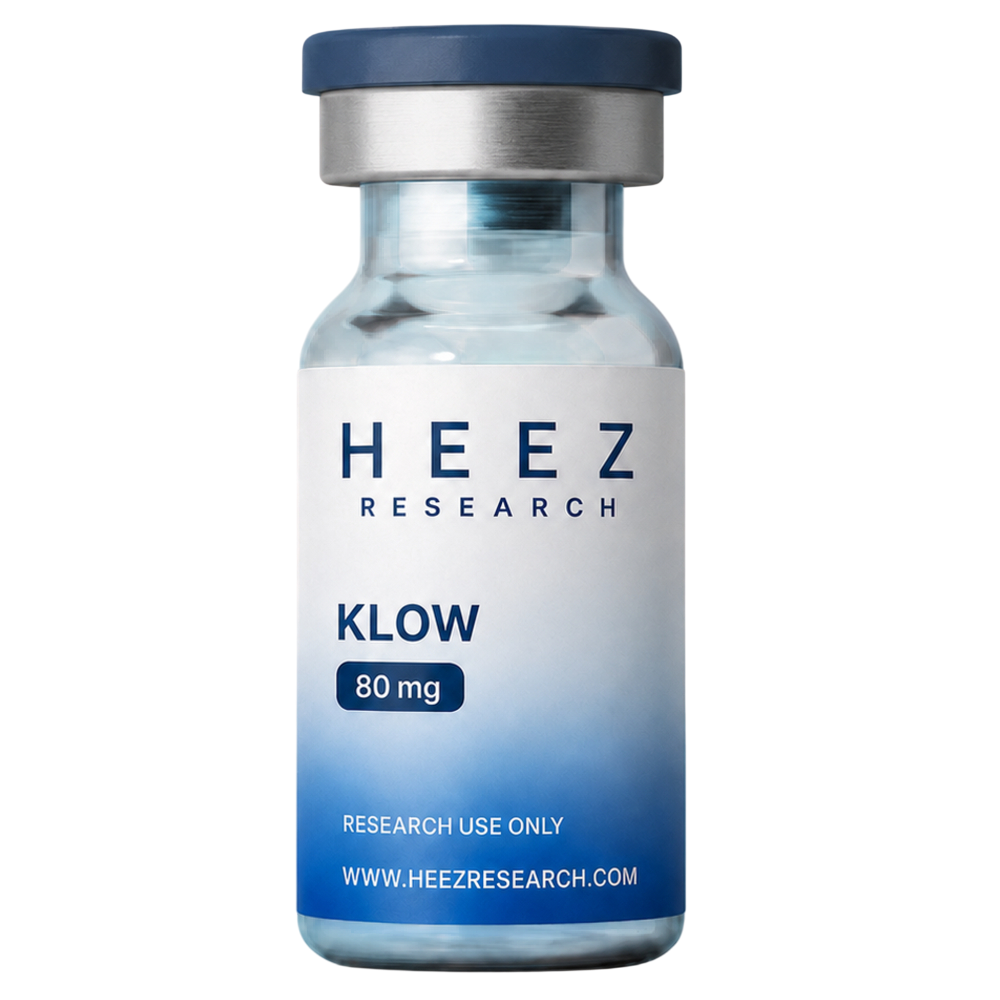
KLOW is available at HEEZ Research
This calculator performs arithmetic on the numbers you enter. It is not medical advice, does not tell you what dose to take, and is not a substitute for guidance from a qualified clinician.
KLOW peptide blend injection frequency isn't a number set by a drug label, because none of the blend's four components — GHK-Cu, KPV, BPC-157, and TB-500 — carry an approved injectable label to set one. That puts KLOW in a different position from a peptide with a cleared indication, where frequency comes from completed human trials. This reference explains what actually determines frequency in KLOW research protocols, and how frequency interacts with the blend's reconstitution math to decide how long a vial lasts. It is written for research and educational purposes only and is not medical advice.
No approved label sets a fixed frequency
Some research peptides carry an FDA-approved formulation with a labeled schedule — tesamorelin, for instance, has an approved once-daily label for its narrow indication, indexed on DailyMed (NIH/NLM). None of KLOW's four components has an equivalent approved injectable drug label, and packaging them together doesn't change that. Without that regulatory anchor, there's no single "correct" KLOW peptide blend injection frequency — only frequencies that show up across different research write-ups, which vary from source to source.
That absence of a fixed standard matches how KLOW is treated elsewhere on this site: there's no official water volume for reconstitution either, only a common reference point (3 mL for an 80 mg vial) chosen for a readable syringe mark. Frequency works the same way — a protocol detail, not a figure handed down from an approved label.
What frequency actually controls
Frequency answers one question: how many times per period does a draw come out of the vial. It says nothing about a separate question: what concentration is in the vial. That second question is fixed the moment bacteriostatic water is added, and for a premixed blend it fixes the ratio between components too:
Concentration = vial total mg ÷ water added (mL)
A KLOW vial reconstituted to a given concentration stays at that concentration through every draw, and the 5:1:1:1 ratio between GHK-Cu, KPV, BPC-157, and TB-500 stays fixed with it — whether the schedule calls for a daily draw or a weekly one. Frequency and concentration are independent variables that combine into a third, more practical number: how many days a single vial actually covers.
Worked example: vial life at two frequencies
Take the standard reference setup used elsewhere on this site: an 80 mg KLOW vial (50 mg GHK-Cu, 10 mg KPV, 10 mg BPC-157, 10 mg TB-500) reconstituted with 3 mL of bacteriostatic water, at a 2 mg target dose per draw, matching the KLOW peptide blend dosage guide.
Step 1 — concentration. 80 mg ÷ 3 mL ≈ 26.7 mg/mL.
Step 2 — volume per dose. 2 mg ÷ 26.7 mg/mL ≈ 0.075 mL.
Step 3 — syringe units. On a U-100 insulin syringe, 1 mL equals 100 units, so 0.075 mL × 100 = 7.5 units per draw.
Step 4 — doses per vial. 80 mg ÷ 2 mg = 40 doses. This depends only on vial total and dose size — the water volume in Step 1 doesn't change it.
Step 5 — vial life by frequency. At once daily, 40 doses run 40 days, about 5.7 weeks. At every other day, the same 40 doses stretch to 40 × 2 = 80 days, about 11.4 weeks. Neither frequency is a recommendation here — they're two illustrative points showing how the same vial and dose produce different vial-life figures depending on how often it's drawn.
A 40 mg vial (25 mg GHK-Cu, 5 mg KPV, 5 mg BPC-157, 5 mg TB-500) — half the reference size — follows the same formula at a lower total. Reconstituted with 1.5 mL of water, it holds the same 26.7 mg/mL concentration and the same 7.5-unit draw for a 2 mg dose, but only 40 mg ÷ 2 mg = 20 doses: 20 days once daily, 40 days every other day.
| Vial size | Water added | Concentration | 2 mg dose (units) | Doses per vial | Vial life — once daily | Vial life — every other day |
|---|---|---|---|---|---|---|
| 40 mg | 1.5 mL | ≈26.7 mg/mL | 7.5 units | 20 | 20 days (~2.9 weeks) | 40 days (~5.7 weeks) |
| 80 mg | 3 mL | ≈26.7 mg/mL | 7.5 units | 40 | 40 days (~5.7 weeks) | 80 days (~11.4 weeks) |
Frequency and the fixed 5:1:1:1 ratio
Because KLOW ships premixed, every one of those 2 mg draws splits across components at the vial's 5:1:1:1 ratio: 1.25 mg GHK-Cu, 0.25 mg KPV, 0.25 mg BPC-157, and 0.25 mg TB-500 per dose. Multiply that split by the 40 doses in the 80 mg reference vial and the totals land exactly back on the label — 40 × 1.25 mg = 50 mg GHK-Cu, and 40 × 0.25 mg = 10 mg each of KPV, BPC-157, and TB-500. If a frequency and dose size don't divide evenly back into those four component amounts, the input numbers are worth rechecking first.
Frequency and dose size are separate decisions
It's easy to assume a higher KLOW injection frequency automatically means a smaller per-draw dose, since that pattern shows up in some protocols. The arithmetic doesn't require it. A protocol can hold the 2 mg dose steady and simply draw from the vial more often, which draws it down faster and shortens vial life, or it can lower the dose to stretch the same vial across more frequent draws. Frequency, dose size, and vial life are three separate numbers connected by the doses-per-vial formula above — changing one doesn't automatically change another unless the protocol is designed that way.
Why research protocols on frequency disagree
Because there's no approved label to converge around, published and self-reported KLOW protocols describe a range of schedules rather than one standard. Some describe daily draws; others space them out further. This guide doesn't recommend a frequency or take a position on which protocol is better — that's a research design question outside the scope of a reconstitution reference. What the math above shows is how any given frequency plays out against a specific vial size, water volume, and dose once you've settled on one.
Keeping frequency and concentration from drifting apart
A frequency-based vial-life estimate only holds if the concentration behind it hasn't changed. Track the date a KLOW vial was reconstituted, not just when it was opened — see how to store reconstituted peptides for the general reasoning. If a vial that should supply 40 doses at 26.7 mg/mL runs out sooner than the frequency and dose size predict, the concentration used in the original calculation is the more likely source of the mismatch, not the compound itself.
Common mistakes
- Looking for an official KLOW peptide blend injection frequency. No approved label sets one for the blend or any of its four components — treat any specific number as a protocol detail, not a standard.
- Assuming frequency changes concentration or ratio. Neither changes. Concentration and the 5:1:1:1 split are both fixed at reconstitution; frequency only affects how fast the vial's total mg gets drawn down.
- Trying to dose the four components on separate schedules from one vial. A premixed KLOW vial delivers all four peptides together on every draw. A separate frequency per component requires separate single-peptide vials, not a single blend.
- Reusing a vial-life estimate after changing the water volume or dose. The 40-day and 80-day figures above only hold at 26.7 mg/mL and a 2 mg dose. Change either input and the vial-life number changes with it.
Use the calculator
Enter your KLOW vial's total mg, bacteriostatic water volume, and target dose into the peptide calculator to get the exact concentration, draw volume, and syringe units, then apply your intended frequency to the doses-per-vial figure to estimate vial life. For the component-by-component ratio behind each draw, see the KLOW peptide blend dosage guide.
Frequently Asked Questions
- Is there an official KLOW peptide blend injection frequency?
- No. GHK-Cu, KPV, BPC-157, and TB-500 each lack an approved injectable drug label of their own, and combining the four into a KLOW blend doesn't create one. Without a regulatory anchor, frequency is a protocol detail that varies across research write-ups rather than a fixed standard.
- Does injection frequency change the KLOW blend's concentration or ratio?
- No. Concentration is set once, at reconstitution, by the vial's total mg divided by the water added. The 5:1:1:1 ratio between GHK-Cu, KPV, BPC-157, and TB-500 is fixed before the water goes in. Frequency only affects how many times you draw from that same solution.
- How do I estimate how long a KLOW vial lasts at a given frequency?
- Divide the vial's total mg by the target dose to get doses per vial, then divide that by how often you draw. An 80 mg vial dosed at 2 mg holds 40 doses — 40 days at once daily, or 80 days at every other day.
- Can I inject the four KLOW components at different frequencies?
- Not from a single premixed vial. GHK-Cu, KPV, BPC-157, and TB-500 are dissolved together in one solution, so every draw pulls all four at the vial's fixed ratio. Giving each component its own frequency would require reconstituting separate single-peptide vials instead.
Ready to calculate? Use the free peptide reconstitution calculator →