GLOW vs KLOW Peptide Blend: Ingredients and Dosing Compared
By PeptCalc Research — Medically reviewed by David Mansour, MD — Last reviewed July 20, 2026
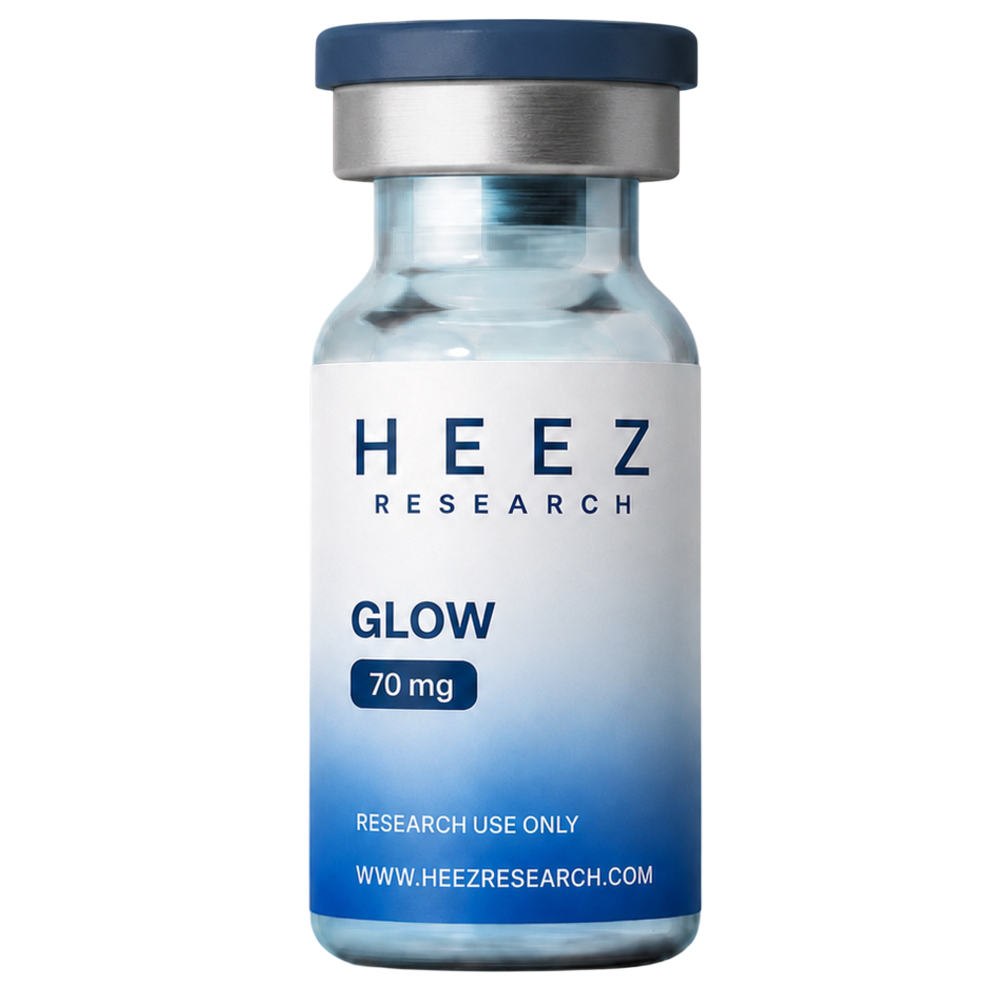
GLOW is available at HEEZ Research
This calculator performs arithmetic on the numbers you enter. It is not medical advice, does not tell you what dose to take, and is not a substitute for guidance from a qualified clinician.
GLOW and KLOW are two premixed peptide blends that share three of their four ingredients, and the name difference marks the one that isn't shared. GLOW combines GHK-Cu, BPC-157, and TB-500. KLOW is that same combination with KPV added. Because the vials look similar on a supplier page and get discussed in the same conversations, it's easy to treat them as interchangeable. They aren't — the extra peptide changes the total mg on the label and therefore the reconstitution math. This comparison lines up what separates GLOW and KLOW and what the calculator does the same way for both. It is written for research and educational purposes only and is not medical advice.
What separates GLOW and KLOW
GLOW is typically supplied as a three-peptide blend: GHK-Cu, a copper-binding peptide studied in skin and tissue research; BPC-157, a peptide studied in gut and localized tissue-repair research; and TB-500, a peptide studied in cell-migration and systemic repair research. KLOW starts from that same three-peptide base and adds KPV, a tripeptide studied separately in inflammation-related research. The addition of KPV is the entire difference between the two names — everything else about how the blends are handled, reconstituted, and drawn follows the same rules.
Because KLOW contains everything GLOW contains plus one more compound, it is sometimes described as an "upgraded" GLOW. That framing is misleading. KPV isn't a stronger dose of GHK-Cu, BPC-157, or TB-500 — it's a distinct peptide with its own research profile. Adding it changes what's in the vial; it doesn't change the potency of the three ingredients GLOW and KLOW have in common.
Vial formats and typical totals
Both blends arrive as lyophilized powder in a single premixed vial, most often at these reference splits:
| Blend | Typical components | Common total |
|---|---|---|
| GLOW | 50 mg GHK-Cu, 10 mg BPC-157, 10 mg TB-500 | 70 mg |
| KLOW | 50 mg GHK-Cu, 10 mg KPV, 10 mg BPC-157, 10 mg TB-500 | 80 mg |
These splits are common reference points, not fixed rules — a supplier can list a different total on the label. The peptide calculator works from whatever total mg your own vial states, so the 70 mg and 80 mg figures here are illustrative rather than universal.
Worked example: same formula, different totals
The reconstitution formula doesn't change based on which blend is in the vial: concentration equals total mg divided by water volume, and units equal that volume in mL multiplied by 100 on a U-100 insulin syringe.
GLOW. A 70 mg vial reconstituted with 3 mL of bacteriostatic water is 70 ÷ 3 = 23.33 mg/mL. A 2 mg target dose is 2 ÷ 23.33 = 0.0857 mL, or 0.0857 × 100 ≈ 8.6 units.
KLOW. An 80 mg vial reconstituted with the same 3 mL of bacteriostatic water is 80 ÷ 3 ≈ 26.7 mg/mL. The same 2 mg target dose is 2 ÷ 26.7 = 0.075 mL, or 0.075 × 100 = 7.5 units.
Same water volume, same target dose in mg, different unit reading — because KLOW's extra 10 mg of KPV raises the vial's total mass without changing the water added, which raises the concentration and lowers the volume needed for the same mg dose. That gap exists purely because the totals differ, not because either blend is more potent per milligram.
Why one calculator covers both
A U-100 insulin syringe reads a fixed 100 units per mL no matter what's dissolved in the water. What changes between GLOW and KLOW is the total mg on the label, and total mg is exactly the number the calculator's concentration step depends on. That's why the same tool handles both blends without any blend-specific adjustment: enter the vial's actual total mg and the water volume used, and the output is correct whether the vial holds three peptides or four. For the reconstitution steps themselves — swabbing the stopper, adding water slowly, swirling instead of shaking — see how to reconstitute peptides.
Where the comparison breaks down
The math is identical; the ingredient lists are not. GLOW's three components and KLOW's four components each carry their own separate research literature, and KPV's inclusion in KLOW doesn't inherit any research backing GHK-Cu, BPC-157, or TB-500 individually. Treating the two blends as the same compound at different strengths is the most common misunderstanding in comparing them — they're different formulations, and a protocol written for one shouldn't be assumed to transfer to the other.
Common mistakes
- Assuming KLOW is a stronger GLOW. KPV is a separate peptide, not a concentration boost on GLOW's existing three ingredients.
- Reusing a GLOW water volume for a KLOW vial, or the reverse. A 3 mL water volume gives 70 mg GLOW and 80 mg KLOW two different concentrations. Recalculate for each vial's actual total.
- Entering one component's mg instead of the vial total. Typing "50" for either blend because that's the GHK-Cu share ignores the other ingredients actually in the vial.
- Mixing up mg and mcg. The calculator works in mg; since 1 mg equals 1000 mcg, a figure entered in the wrong unit is off by a factor of 1000.
- Shaking the vial. Swirl gently instead — shaking can degrade the peptides in either blend.
Related
For the GLOW-specific breakdown and calculator walkthrough, see the GLOW peptide blend calculator guide. For the KLOW-specific version with the KPV component included, see the KLOW peptide blend calculator guide. Or enter your own vial's total mg, water volume, and target dose directly into the free peptide calculator to get an exact unit reading for either blend.
Frequently Asked Questions
- What is the difference between GLOW and KLOW?
- GLOW combines GHK-Cu, BPC-157, and TB-500 in one vial. KLOW adds a fourth peptide, KPV, to that same three-peptide base. The extra ingredient is the entire distinction between the two names.
- Is KLOW just a stronger version of GLOW?
- No. KPV is not a higher dose of anything already in GLOW — it's a separate peptide studied in a different research context. KLOW is a different four-peptide combination, not a concentrated GLOW.
- Do GLOW and KLOW use the same reconstitution math?
- Yes. Both are premixed blends, so the calculator works from each vial's combined total mg rather than any single component. Concentration equals total mg divided by water volume, and units equal that volume in mL times 100 on a U-100 syringe, regardless of which blend is in the vial.
- Can I substitute a GLOW vial for a KLOW vial in a protocol that calls for one or the other?
- No. They are different combinations of research compounds with different total mg on typical labels. Treat any protocol's blend and vial size as specific to that blend, not interchangeable with the other.
Ready to calculate? Use the free peptide reconstitution calculator →