GLOW Peptide Blend Bac Water Ratio Guide
By PeptCalc Research — Medically reviewed by David Mansour, MD — Last reviewed July 31, 2026
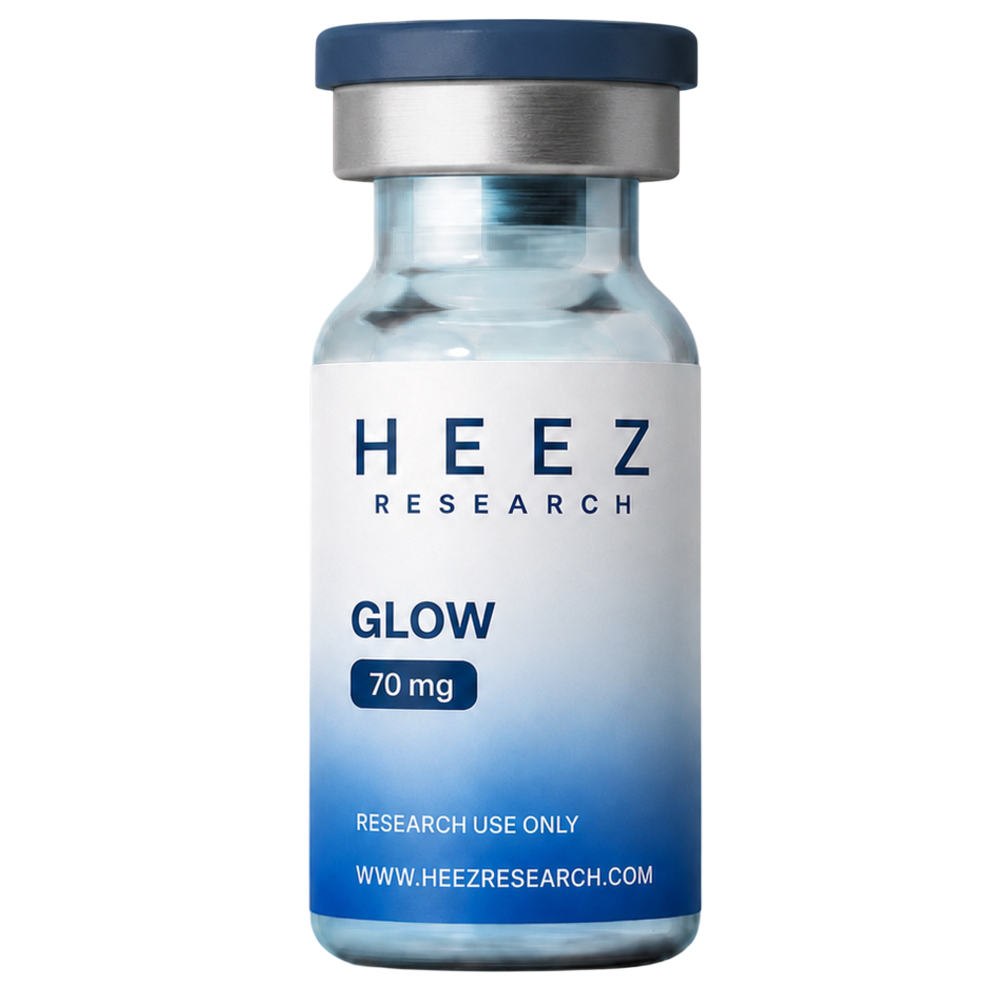
GLOW is available at HEEZ Research
This calculator performs arithmetic on the numbers you enter. It is not medical advice, does not tell you what dose to take, and is not a substitute for guidance from a qualified clinician.
A GLOW peptide blend bac water ratio is the amount of bacteriostatic water added to a GLOW vial relative to the total peptide mass inside it, and it is the single number that determines everything downstream: concentration, draw volume, and the reading on a syringe. This reference explains how to choose a GLOW peptide blend bac water ratio, convert it into a concentration, and read the result in syringe units. It is written for research purposes only and is not medical advice.
What a bac water ratio means for GLOW
A bac water ratio is usually written as water volume per unit of peptide mass — "3 mL per 70 mg," for example. That ratio fixes the concentration once the powder dissolves, and concentration is what turns a target dose into a specific syringe reading. Two GLOW vials holding identical total mg can require completely different draw volumes if they were mixed with different amounts of bacteriostatic water. The ratio is set the moment water goes into the vial, which is why it's worth checking with the calculator before reconstituting rather than after.
One vial, one ratio, three peptides
GLOW differs from a two-peptide blend in one respect worth flagging up front: it ships as GHK-Cu, BPC-157, and TB-500 premixed in a single lyophilized vial, commonly at a 5:1:1 ratio by weight. There's no separate-vial option and no way to reconstitute one component on its own. That means only one bac water ratio decision applies to the whole vial — it sets the concentration for the combined solution, and the 5:1:1 split between the three peptides rides along unchanged no matter how much water is added.
The two common vial totals seen from research suppliers are 35 mg (25 mg GHK-Cu / 5 mg BPC-157 / 5 mg TB-500) and 70 mg (50 mg GHK-Cu / 10 mg BPC-157 / 10 mg TB-500). Check the actual mg total printed on your own vial before choosing a water volume — labeling isn't standardized across every supplier.
Common GLOW bac water ratios
The table below shows how different bac water volumes change the concentration of a 70 mg GLOW vial (50 mg GHK-Cu / 10 mg BPC-157 / 10 mg TB-500):
| Bac water added | Total concentration | GHK-Cu concentration | BPC-157 + TB-500 concentration (each) |
|---|---|---|---|
| 1 mL | 70 mg/mL | 50 mg/mL | 10 mg/mL |
| 2 mL | 35 mg/mL | 25 mg/mL | 5 mg/mL |
| 3 mL | ≈23.3 mg/mL | ≈16.7 mg/mL | ≈3.3 mg/mL |
| 5 mL | 14 mg/mL | 10 mg/mL | 2 mg/mL |
None of these ratios is wrong on its own. A smaller water volume concentrates the dose into a smaller draw, which can be harder to measure accurately on a syringe. A larger water volume spreads the same dose across a bigger draw, generally easier to read but faster to empty the vial if the typical dose is small.
Turning a ratio into syringe units — the math
The GLOW peptide blend bac water ratio becomes a usable number in three steps.
Step 1: Concentration = vial mass ÷ water volume. A 70 mg GLOW vial with 3 mL of bacteriostatic water added is 70 ÷ 3 ≈ 23.3 mg/mL.
Step 2: Volume = dose ÷ concentration. A 2 mg total dose at 23.3 mg/mL works out to 2 ÷ 23.3 ≈ 0.086 mL.
Step 3: Units = volume (mL) × 100. On a U-100 insulin syringe, 1 mL equals 100 units, so 0.086 × 100 ≈ 8.6 units.
That 2 mg draw still carries the vial's fixed 5:1:1 split even though the calculator only returns one combined unit reading: 2 mg × (5 ÷ 7) ≈ 1.43 mg GHK-Cu, and 2 mg × (1 ÷ 7) ≈ 0.29 mg each of BPC-157 and TB-500. Changing the bac water ratio changes the concentration and the unit reading, never that underlying proportion. Rather than working through this by hand for every water volume and dose, enter the numbers into the peptide calculator and it returns the concentration and unit reading directly.
Picking a ratio in reverse, to land on a clean syringe reading
Sometimes the more useful question runs the other way: given a typical dose, what bac water ratio produces a syringe reading that's easy to draw and double-check? Take the same 70 mg GLOW vial and a 2 mg target dose. To land that dose on exactly 10 units (0.10 mL), the concentration needs to be dose ÷ volume = 2 ÷ 0.10 = 20 mg/mL. Working backward, water volume = vial mass ÷ concentration = 70 ÷ 20 = 3.5 mL. Reconstituting that vial with 3.5 mL instead of 3 mL puts a 2 mg dose exactly on the 10-unit mark — a cleaner reading on most U-100 syringes than 8.6. The peptide dosage calculator runs this reverse calculation directly: enter the vial's total mg, target dose, and desired unit reading, and it returns the water volume that produces it.
Mixing steps
- Gather the GLOW vial, bacteriostatic water, a U-100 insulin syringe, and alcohol swabs.
- Swab the vial stopper with alcohol.
- Draw the bac water volume your chosen ratio calls for.
- Inject it slowly down the inside wall of the vial, not directly onto the powder.
- Swirl gently until fully dissolved — do not shake.
- Confirm the resulting concentration matches what you entered into the calculator before drawing a dose.
For the general steps that apply to any peptide vial, see how to reconstitute peptides.
Storage
Reconstituted GLOW vials are generally stored refrigerated and protected from light, the same as any reconstituted peptide solution. Unreconstituted lyophilized powder is more stable than the mixed solution, which is why the vial ships dry. Track the date the vial was reconstituted, particularly if a GLOW vial sits in the fridge next to single-peptide vials at different ratios.
Common mistakes
- Entering one component's mg instead of the vial total. Typing "50" for a 70 mg vial because that's the GHK-Cu share throws off the concentration for the whole solution.
- Reusing a bac water volume from a different vial size without recalculating. A ratio worked out for a 70 mg vial doesn't transfer to a 35 mg vial without redoing the division.
- Mixing up mg and mcg. 1 mg equals 1000 mcg — confirm which unit a number refers to before it goes into the calculator.
- Shaking instead of swirling. Shaking can degrade the peptides; a gentle swirl is enough to dissolve the powder.
- Assuming a non-U-100 syringe. The unit conversions above hold only for a standard U-100 insulin syringe, where 1 mL equals 100 units.
Evidence level
GHK-Cu, BPC-157, and TB-500 are each studied individually in preclinical research — largely animal models and in-vitro work — rather than large controlled human trials. None of the three is FDA-approved for human use, and combining them into a GLOW vial at any bac water ratio doesn't change that evidence picture for any individual component. Treat GLOW as a research compound rather than a proven human therapeutic.
Use the calculator
Enter your GLOW vial's actual total mg and a candidate bac water volume into the peptide calculator to see the resulting ratio, concentration, and syringe units for any target dose, or run reverse mode to find the water volume that lands a chosen dose on a clean unit mark. For the physical reconstitution steps in more detail, see the GLOW peptide blend reconstitution calculator guide. The calculator handles the arithmetic; this guide explains what the ratio means before the water ever meets the powder.
Frequently Asked Questions
- What bac water ratio is typically used for a GLOW peptide blend?
- A frequently cited starting point for a 70 mg GLOW vial (50 mg GHK-Cu, 10 mg BPC-157, 10 mg TB-500) is 3 mL of bacteriostatic water, giving about 23.3 mg/mL. That is one common reference point, not a required ratio — less water concentrates the draw, more water spreads it out, and the calculator works for whatever ratio you choose.
- Does the bac water ratio split differently across GHK-Cu, BPC-157, and TB-500?
- No. GLOW ships premixed in one vial, so a single bac water ratio sets the concentration for the whole solution at once. The 5:1:1 split between the three peptides stays fixed regardless of how much water is added — water volume changes concentration, not the ratio between components.
- How much bacteriostatic water should I add to a 35 mg GLOW vial?
- That depends on the concentration you want. 1 mL of water in a 35 mg vial gives 35 mg/mL; 2 mL gives 17.5 mg/mL. Enter the vial's actual total mg and a candidate water volume into the calculator to see the resulting concentration and syringe reading before mixing anything.
- What happens if I add more bacteriostatic water than my usual GLOW ratio calls for?
- More water lowers the concentration, so a larger draw volume is needed to reach the same target dose. The total peptide mass in the vial doesn't change, only how spread out it is across the liquid. Recalculate the ratio any time the water volume changes.
Ready to calculate? Use the free peptide reconstitution calculator →