CJC-1295 & Ipamorelin Vial Size Guide
By PeptCalc Research — Medically reviewed by David Mansour, MD — Last reviewed September 14, 2026
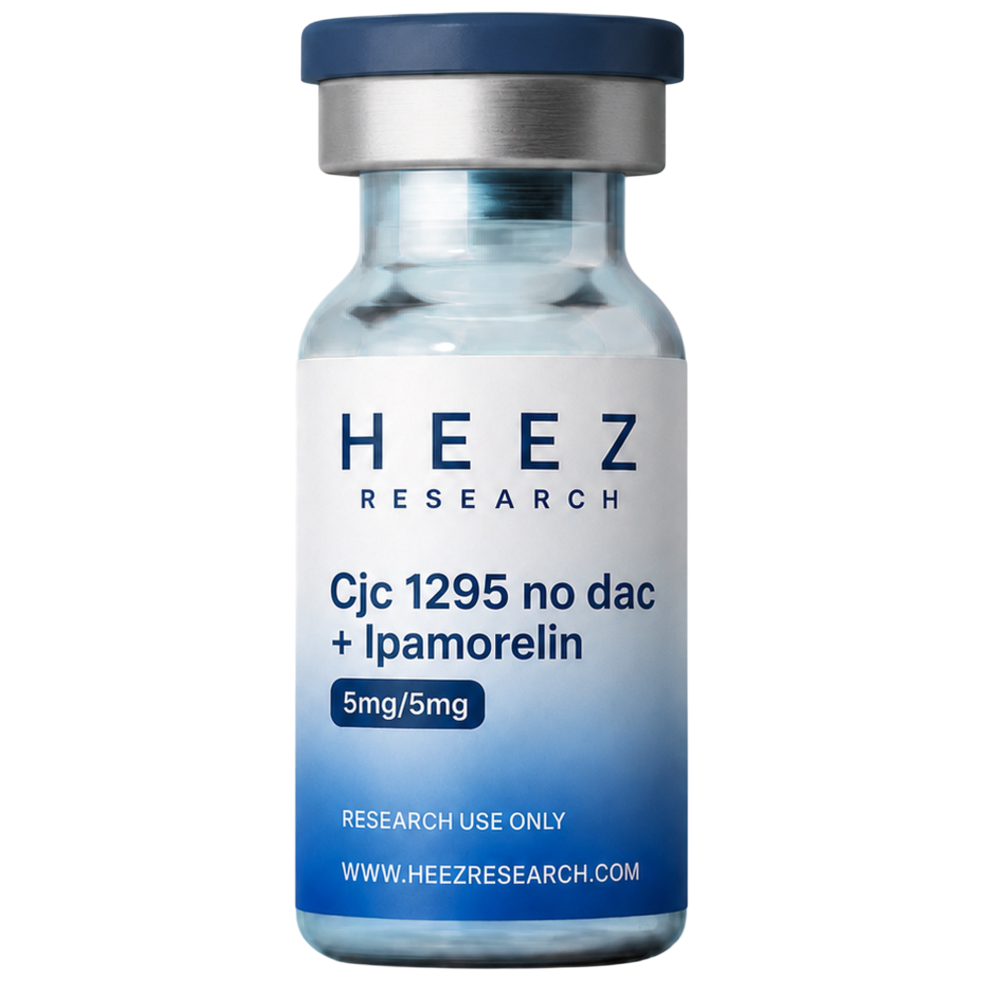
CJC-1295 & Ipamorelin is available at HEEZ Research
This calculator performs arithmetic on the numbers you enter. It is not medical advice, does not tell you what dose to take, and is not a substitute for guidance from a qualified clinician.
A CJC-1295 Ipamorelin vial size guide answers a supply question, not a draw-math question: how much total peptide does a given vial actually get you, and how do you size a vial to match a planned protocol length? Vial size is fixed once a vial is manufactured and is labeled in milligrams, but what that label means day to day depends on the target dose and the bacteriostatic water volume chosen at reconstitution. This guide walks through what vial size does and doesn't determine. It is written for research and educational purposes only and is not medical advice.
Common CJC-1295/Ipamorelin blend vial sizes
Research CJC-1295/Ipamorelin blends are most often supplied pre-mixed in one vial, commonly at a 1:1 ratio by weight:
| Blend vial (total mass) | Typical use case |
|---|---|
| 4 mg (2 mg CJC-1295 / 2 mg Ipamorelin) | Shorter protocols, or lower per-draw doses |
| 10 mg (5 mg / 5 mg) | The most commonly referenced size |
| 20 mg (10 mg / 10 mg) | Longer protocols, or fewer vials needed overall |
All three sizes are lyophilized powder and follow the same reconstitution formula — concentration equals total vial mass divided by the bacteriostatic water added. Only the total milligrams available changes between them. Check the label before assuming which format you have: a "5 mg/5 mg" vial holds 10 mg total, not 5 mg, and that distinction changes every number that follows. This CJC-1295 Ipamorelin vial size guide uses the 10 mg and 20 mg sizes as reference points throughout, since they're the two most commonly stocked.
Vial size sets total mg, not the size of one draw
This is the point most worth separating from a per-unit dosage chart: vial size determines how many total milligrams the vial holds across its full life, not how large any single dose is. A 1 mg draw is a 1 mg draw whether it came from a 10 mg vial or a 20 mg vial. What changes is how many of those 1 mg draws each vial can supply before it's empty.
The formula for that is simple:
Doses per vial = total vial mass (mg) ÷ target dose (mg)
Worked example: doses per vial at a 1 mg target dose
Take a 1 mg blend target dose and compare the two common sizes:
- 10 mg vial: 10 ÷ 1 = 10 doses
- 20 mg vial: 20 ÷ 1 = 20 doses
Doubling the vial size exactly doubles the doses on hand, because the target dose didn't change. This holds regardless of how much bacteriostatic water goes into either vial — water volume changes the concentration and the mL and unit reading of a single draw, but it does not touch the total mg in the vial or the total doses that mg supports.
Water volume changes the draw, not the count
To see that water volume is a separate variable from vial size, reconstitute the 20 mg vial two different ways and compare the same 1 mg draw:
| Blend vial | Water added | Concentration | 1 mg dose (units, U-100 syringe) | Doses per vial |
|---|---|---|---|---|
| 20 mg | 4 mL | 5 mg/mL | 20 units | 20 |
| 20 mg | 8 mL | 2.5 mg/mL | 40 units | 20 |
Step through the second row. Concentration: 20 mg ÷ 8 mL = 2.5 mg/mL. Draw volume: 1 mg ÷ 2.5 mg/mL = 0.4 mL. Syringe units on a U-100 insulin syringe (1 mL = 100 units): 0.4 mL × 100 = 40 units.
Both rows come from the identical 20 mg vial and the identical 1 mg target dose, so both hold exactly 20 doses. The only thing water volume changed was the unit reading — 20 units versus 40 units — which is a question of what reads cleanly on the syringe barrel, not a question of total supply.
Matching vial size to a protocol length
Because doses per vial follows directly from total mass and target dose, sizing a vial (or vials) to a planned protocol is a matter of running the formula backward:
Total mg needed = number of planned doses × dose size (mg)
Worked example. A protocol calling for a 0.5 mg blend dose once daily for 30 days needs 30 doses. Total mg required: 30 × 0.5 mg = 15 mg. A single 10 mg vial supplies 10 ÷ 0.5 = 20 doses, which covers 20 of the 30 days but runs out with 10 days left. A single 20 mg vial supplies 20 ÷ 0.5 = 40 doses — enough to cover the full 30-day run with 10 doses to spare.
Running this arithmetic before ordering is the whole point of a CJC-1295 Ipamorelin vial size guide: it turns "which size should I buy" into a total-mg question with one clear answer, rather than a guess.
Blend vials vs. separate vials
Some suppliers reconstitute CJC-1295 and Ipamorelin as two separate vials instead of one pre-blended vial. Vial size math applies to each vial independently in that case — a separate 5 mg CJC-1295 vial and a separate 5 mg Ipamorelin vial each hold their own total mg and their own doses-per-vial count. Splitting the peptides this way lets the ratio between them be adjusted at draw time, which a pre-blended vial does not allow. For the concentration math specific to each format, see CJC-1295 & Ipamorelin dosage chart.
Common mistakes
- Assuming a bigger vial means a bigger single dose. Vial size sets total supply, not draw size. The target dose sets draw size.
- Forgetting that water volume doesn't change total doses. It changes the mL and unit reading per draw, not how many draws the vial holds.
- Reading a blend label as per-peptide when it's total mass. A "5 mg/5 mg" vial is 10 mg total, not 5 mg.
- Ordering by vial count instead of total mg. Two 10 mg vials and one 20 mg vial contain the same total peptide — plan around milligrams, not the number of boxes.
- Mixing up mg and mcg. CJC-1295 and Ipamorelin doses are described in either unit depending on the source; 1 mg equals 1000 mcg.
Use the calculator
For the doses-per-vial and total-mg math in this guide, a calculator isn't strictly necessary — it's two divisions. Where a tool earns its keep is the per-draw conversion: enter a vial size, water volume, and target dose into the peptide reconstitution calculator to get exact mL and syringe units for that specific draw, or run reverse mode to find the water volume that lands a chosen dose on a whole unit mark. For the full mixing steps for this blend, see CJC-1295 & Ipamorelin dosage calculator.
Related: the free peptide calculator handles any vial size and water volume directly, and the CJC-1295 & Ipamorelin dosage chart has pre-worked unit tables at the reference concentrations used above.
Frequently Asked Questions
- What CJC-1295/Ipamorelin blend vial sizes are most common?
- 10 mg total (5 mg CJC-1295 / 5 mg Ipamorelin) and 20 mg total (10 mg / 10 mg) are the two sizes seen most often in research supply, alongside a smaller 4 mg total (2 mg / 2 mg) option. All three follow the same reconstitution math — total mass divided by water volume.
- Does a bigger CJC-1295/Ipamorelin vial mean a bigger single dose?
- No. Vial size sets the total milligrams available across the vial's life, not the size of any one draw. The target dose and the water volume used at reconstitution are what set the mL and syringe units for a single draw.
- How many doses does a 20 mg CJC-1295/Ipamorelin vial hold?
- Divide the vial's total mg by the target dose in mg. A 20 mg vial dosed at 1 mg per draw holds 20 doses. A 10 mg vial at the same 1 mg dose holds 10 doses. The water volume used to reconstitute doesn't change this count.
- How do I pick between a 10 mg and 20 mg CJC-1295/Ipamorelin vial?
- Work backward from the planned protocol length. Multiply the number of doses by the per-dose mg to get total mg needed, then choose the vial size, or combination of vials, that covers that total.
Ready to calculate? Use the free peptide reconstitution calculator →