CJC-1295 & Ipamorelin Units Per mL Calculator
By PeptCalc Research — Medically reviewed by David Mansour, MD — Last reviewed August 10, 2026
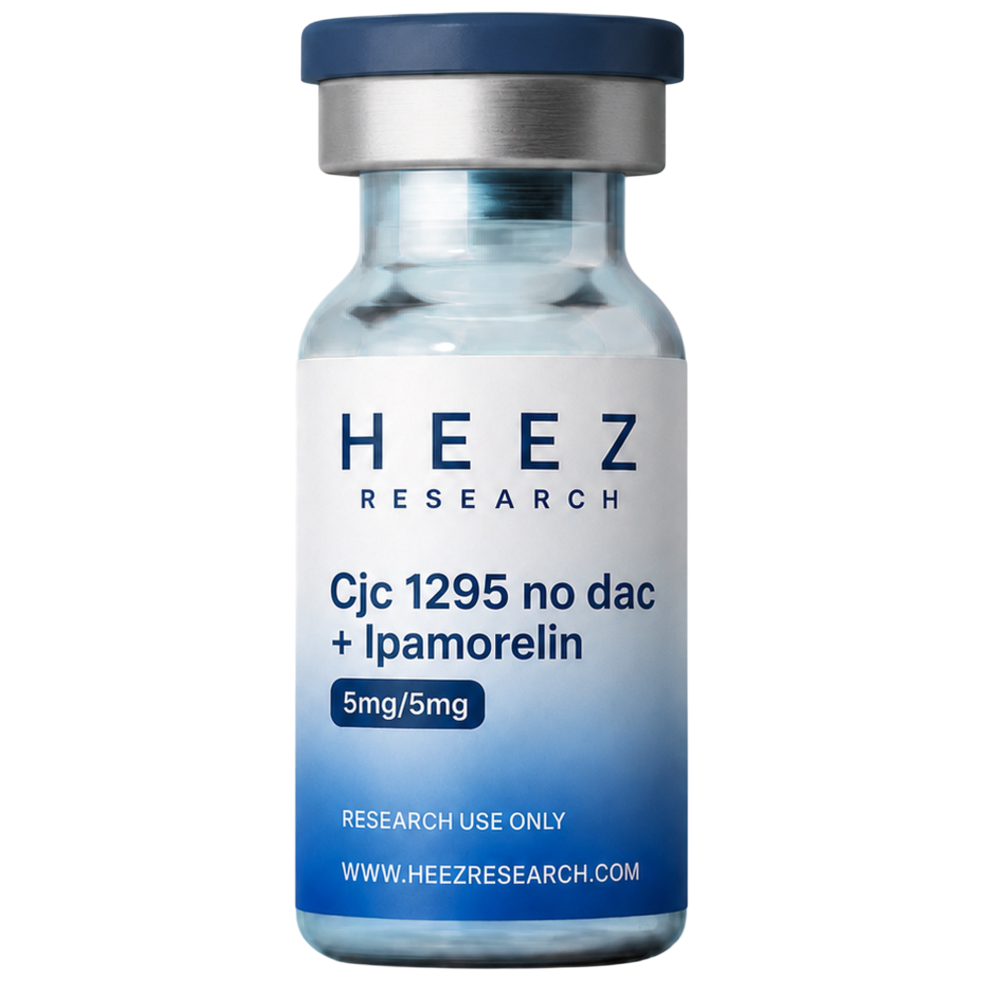
CJC-1295 & Ipamorelin is available at HEEZ Research
This calculator performs arithmetic on the numbers you enter. It is not medical advice, does not tell you what dose to take, and is not a substitute for guidance from a qualified clinician.
A CJC-1295/Ipamorelin vial label states total milligrams, but the number that actually shows up on the syringe is units per mL — and that figure never moves. A U-100 insulin syringe is built to read 100 units per mL, full stop. What changes with reconstitution is how much peptide sits inside each of those units. This is a research reference for that math: how vial concentration sets mg per unit, and how to turn a target dose into an exact draw. It is written for research purposes only and is not medical advice.
What "units per mL" actually means
Every U-100 insulin syringe divides 1 mL into 100 units. That ratio is printed on the barrel and doesn't shift — it's a property of the syringe, not the peptide. A search for a "CJC-1295 Ipamorelin units per mL calculator" usually isn't really asking about the syringe scale; it's asking a different question in disguise: given how this vial was mixed, how much peptide is in each unit, and how many units does a target dose take?
Blend vials vs. separate vials
CJC-1295 and Ipamorelin reach researchers in one of two formats, and the units-per-mL question reads differently for each. A pre-blended vial combines both peptides, commonly at a 1:1 ratio by weight — a "5 mg/5 mg" label means 10 mg total, not 5 mg. One water volume sets the concentration for the blend as a whole, and one draw pulls both peptides at once. Separate vials hold each peptide on its own and can be reconstituted at different water volumes, then drawn independently or combined in one syringe. The math below applies to either format — the vial size and water volume are just different inputs.
What changes: mg per unit
Concentration is vial mass divided by water volume. Once mg/mL is known, dividing by 100 gives mg per unit — the number that actually drives the draw. For a 10 mg blend vial (5 mg CJC-1295 / 5 mg Ipamorelin):
| Water added | Total concentration | mg per unit | Units per mL |
|---|---|---|---|
| 1 mL | 10 mg/mL | 0.1 mg/unit | 100 |
| 2 mL | 5 mg/mL | 0.05 mg/unit | 100 |
| 4 mL | 2.5 mg/mL | 0.025 mg/unit | 100 |
Units per mL never leaves 100. Mg per unit drops as water volume rises, which is the entire lever being pulled when choosing a reconstitution ratio.
Worked example
10 mg blend vial (5 mg CJC-1295 / 5 mg Ipamorelin) + 2 mL bacteriostatic water → 5 mg/mL
- mg per unit: 5 ÷ 100 = 0.05 mg/unit
- 0.5 mg dose ÷ 0.05 mg/unit = 10 units
- 1 mg dose ÷ 0.05 mg/unit = 20 units
20 mg blend vial (10 mg CJC-1295 / 10 mg Ipamorelin) + 4 mL bacteriostatic water → 5 mg/mL
- mg per unit: 5 ÷ 100 = 0.05 mg/unit
- 0.5 mg dose ÷ 0.05 mg/unit = 10 units
- 1 mg dose ÷ 0.05 mg/unit = 20 units
Both vials land on the same unit reading for the same dose, because both were mixed to the same 5 mg/mL concentration — only the total doses on hand differ, which the next section covers.
Now compare a vial mixed to a different concentration. 10 mg vial + 1 mL bacteriostatic water → 10 mg/mL, so mg per unit is 10 ÷ 100 = 0.1 mg/unit. The same 1 mg dose is now 1 ÷ 0.1 = 10 units, not 20. Same dose, same syringe, two different readings — 20 units versus 10 — purely because the vials were reconstituted at different concentrations. Entering a vial size and water volume into the peptide reconstitution calculator removes the need to work this out by hand, and reverse mode finds the water volume that lands a chosen dose on a round unit mark.
Total doses per vial doesn't change
Water volume changes the units per dose. It does not change how much peptide is in the vial or how many doses that vial holds. A 10 mg blend vial at a 1 mg dose provides 10 doses whether it was reconstituted in 1 mL, 2 mL, or 4 mL — only the draw size per dose shifts:
| Water added | Total concentration | Units for a 1 mg dose | Doses in the 10 mg vial |
|---|---|---|---|
| 1 mL | 10 mg/mL | 10 units | 10 |
| 2 mL | 5 mg/mL | 20 units | 10 |
| 4 mL | 2.5 mg/mL | 40 units | 10 |
Choosing a ratio for a clean reading
None of the rows above is wrong — 10 mg of total blend splits into 10 doses either way. What differs is how easy the draw is to read and double-check. A dose that lands on 20 or 40 units is generally easier to draw accurately on a U-100 syringe than one that lands on a fraction of a unit, since small errors matter proportionally more at the low end and the barrel is easier to read at whole-number marks. The CJC-1295 & Ipamorelin bac water ratio guide walks through choosing a water volume that keeps a specific target dose on a clean number.
Reconstitution steps
- Gather the blend or separate vials, bacteriostatic water, alcohol swabs, and a U-100 insulin syringe.
- Swab each vial stopper with alcohol.
- Draw the water volume the chosen ratio calls for.
- Inject it slowly down the inside wall of the vial, not directly onto the powder.
- Swirl gently until fully dissolved — don't shake.
- Confirm the resulting concentration matches what was entered into the calculator before drawing a dose.
For the general mixing process and storage notes that apply to any peptide vial, see how to reconstitute peptides.
Common mistakes
- Treating "units per mL" as if it varies by peptide or concentration. It doesn't — it's fixed at 100 on a U-100 syringe. The number that actually varies is mg per unit.
- Reusing a mg-per-unit figure across a different water volume. Change the water, and mg per unit has to be recalculated — it doesn't carry over from a previous mix.
- Reading a blend label as per-peptide when it's total mass, or the reverse. A "5 mg/5 mg" vial is 10 mg total, not 5 mg, and that distinction changes every number downstream.
- Confusing a smaller unit count with a smaller dose. In the worked example above, 20 units and 10 units can both deliver different doses depending on concentration — the unit count only reflects concentration, not a fixed amount of peptide.
- Mixing up mg and mcg. CJC-1295 and Ipamorelin are described in either unit depending on the source; 1 mg equals 1000 mcg. Confirm which unit a vial label and target dose are both using before converting.
- Using a syringe that isn't U-100. Every calculation here assumes 100 units equal 1 mL. A different syringe scale changes the unit conversion entirely.
Use the calculator
Enter a CJC-1295/Ipamorelin vial size and water volume into the peptide calculator to get concentration, mg per unit, and the exact syringe units for a target dose. Reverse mode runs it the other way — enter a dose and the units to land on, and it returns the water volume that produces it.
For related math, see the CJC-1295 & Ipamorelin dosage chart. The calculator does the arithmetic; this guide explains what the units on the syringe actually represent.
Frequently Asked Questions
- How many units per mL does a CJC-1295/Ipamorelin syringe hold?
- A standard U-100 insulin syringe always reads 100 units per mL, regardless of how the CJC-1295/Ipamorelin vial was reconstituted. What changes with concentration is mg per unit — how much peptide sits in each of those 100 units — not the units-per-mL scale itself.
- How many units is a 1 mg CJC-1295/Ipamorelin blend dose from a 10 mg vial in 2 mL of water?
- That mix works out to 5 mg/mL total, or 0.05 mg per unit. A 1 mg blend dose is 1 divided by 0.05, which is 20 units.
- Does adding more bacteriostatic water change the units per mL?
- No. Units per mL is fixed at 100 by the syringe itself. Adding more water lowers the concentration, so more units are needed to draw the same dose. The total peptide mass in the vial does not change.
- How many total doses does a 10 mg CJC-1295/Ipamorelin vial provide?
- At a 1 mg blend dose, a 10 mg vial provides 10 doses, regardless of how much bacteriostatic water was used to reconstitute it. Water volume changes the draw volume per dose, not the number of doses the vial contains.
Ready to calculate? Use the free peptide reconstitution calculator →