CJC-1295 & Ipamorelin Cycle Length Explained
By PeptCalc Research — Medically reviewed by David Mansour, MD — Last reviewed August 4, 2026
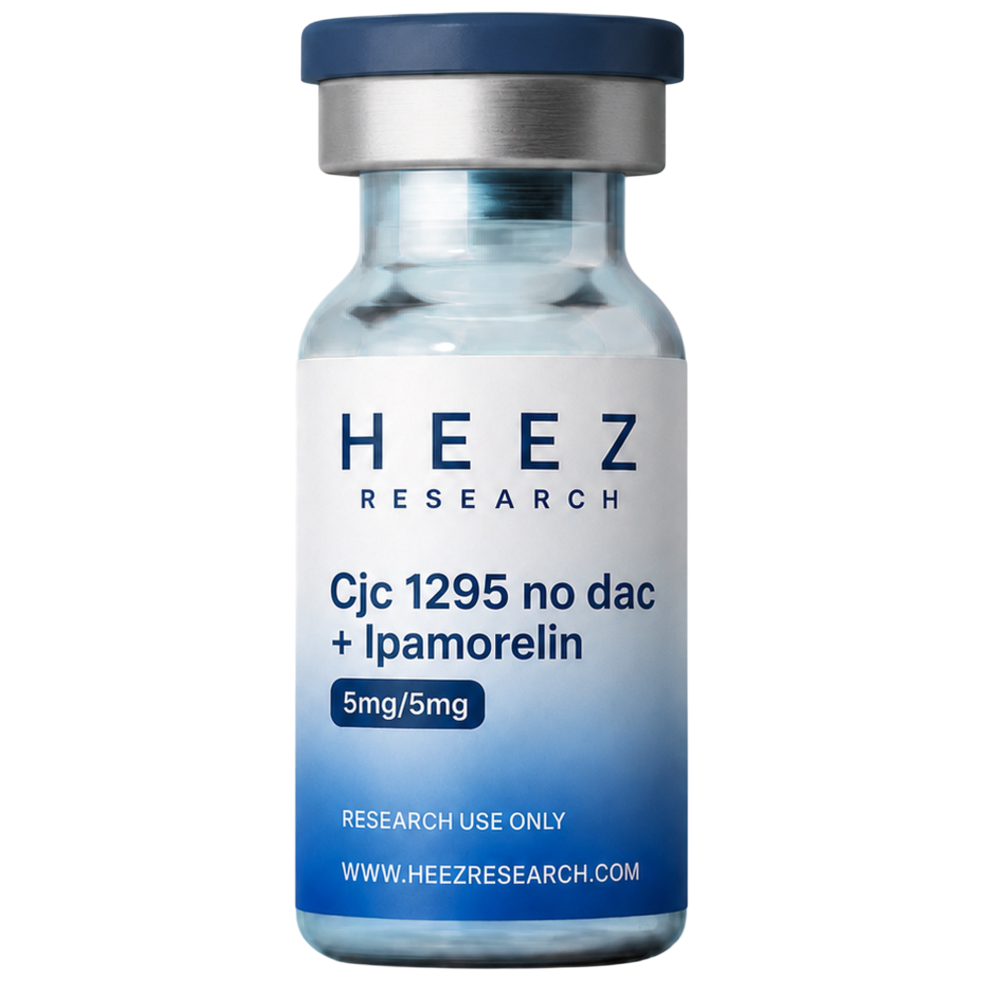
CJC-1295 & Ipamorelin is available at HEEZ Research
This calculator performs arithmetic on the numbers you enter. It is not medical advice, does not tell you what dose to take, and is not a substitute for guidance from a qualified clinician.
CJC-1295/Ipamorelin cycle length isn't a number printed on an approved drug label, because neither peptide carries one. Like injection frequency, cycle length is a protocol variable that research write-ups define differently from source to source. What it reliably changes is arithmetic: how many total doses, and therefore how many vials, a given research cycle consumes once frequency and dose are fixed. This guide walks through that math with a worked example. It is written for research and educational purposes only and is not medical advice.
No approved label sets a cycle length
Some research peptides carry an approved formulation with a labeled schedule — tesamorelin, for instance, has an approved once-daily label for its narrow indication, indexed on DailyMed (NIH/NLM). Neither CJC-1295 nor Ipamorelin has an equivalent approved injectable drug label. Without that regulatory anchor, there is no single "correct" CJC-1295/Ipamorelin cycle length — only cycle structures that show up across different research write-ups, and those structures vary. Some describe continuous use over several weeks; others describe a period of use followed by a scheduled break. Treat any specific number you encounter as one source's protocol design, not a standard.
Cycle length is a different question from injection frequency
It's easy to conflate cycle length with injection frequency, but they answer different questions. Frequency is how often a dose is drawn within a period — once daily, every other day. Cycle length is how many total weeks a protocol runs before stopping or pausing. A protocol can hold frequency constant while cycle length changes, or the reverse. The CJC-1295 & Ipamorelin injection frequency guide covers the frequency side of this in detail; this guide focuses on what happens to vial math as cycle length changes, once frequency and dose are already fixed.
What cycle length actually changes
Cycle length doesn't touch concentration. Concentration is set once, at reconstitution:
Concentration = vial mass (mg) ÷ water added (mL)
That number holds steady through every draw, for the entire working life of a vial, regardless of how many weeks the cycle runs. What cycle length changes is a downstream figure: the total mg a research cycle requires, and therefore how many vials it takes to complete.
Worked example: vial math across an 8-week cycle
Take the same reference setup used elsewhere on this site: a 10 mg blend vial (5 mg CJC-1295 / 5 mg Ipamorelin) reconstituted with 2 mL of bacteriostatic water, at a 0.5 mg blend dose per draw.
Step 1 — concentration. 10 mg ÷ 2 mL = 5 mg/mL.
Step 2 — volume and units per dose. 0.5 mg ÷ 5 mg/mL = 0.1 mL. On a U-100 insulin syringe, 1 mL equals 100 units, so 0.1 mL × 100 = 10 units per draw.
Step 3 — doses per vial. 10 mg ÷ 0.5 mg = 20 doses. This depends only on vial mass and dose size, not on cycle length or frequency.
Step 4 — total doses across the cycle. An 8-week cycle run 5 days a week comes to 8 × 5 = 40 doses. The same 8 weeks run daily comes to 8 × 7 = 56 doses.
Step 5 — vials needed. 40 doses ÷ 20 doses per vial = 2 vials for the 5-day-a-week schedule. 56 doses ÷ 20 = 2.8, which rounds up to 3 vials for daily dosing — a research order can't include a partial vial, so any fractional result rounds up.
| Cycle length | Frequency | Total doses | Total mg needed | Vials needed (10 mg each) |
|---|---|---|---|---|
| 8 weeks | 5x/week | 40 | 20 mg | 2 |
| 8 weeks | daily (7x/week) | 56 | 28 mg | 3 |
| 12 weeks | 5x/week | 60 | 30 mg | 3 |
The 12-week row extends the first row's schedule: 12 × 5 = 60 doses, 60 × 0.5 mg = 30 mg, and 30 mg ÷ 10 mg per vial = 3 vials exactly.
Cycle length, frequency, and dose are three separate dials
None of these three variables forces a change in the others. A longer cycle at the same frequency and dose simply needs more vials — the concentration and the per-dose unit reading (10 units in the example above) don't move. A protocol could instead shorten the cycle and raise frequency to reach a similar total mg, or lower the dose so one vial stretches across a longer cycle. Whichever combination a given protocol uses, the vial math above is what applies once the three numbers are chosen. This guide isn't proposing that any particular combination is preferable.
Off-cycle periods and vial storage
A cycle built around a scheduled break raises a separate, practical question: what happens to a reconstituted vial sitting unused during the off period. That's a storage question, not a cycle-length question, and it's covered in how to store reconstituted peptides. The short version: track the date a vial was reconstituted, not the date the cycle started or paused, since concentration and shelf-life considerations run from reconstitution forward regardless of where the cycle stands.
Common mistakes
- Treating a specific cycle length as the official one. No approved label sets a CJC-1295/Ipamorelin cycle length — any number encountered is a protocol detail from one source, not a standard.
- Confusing cycle length with injection frequency. They're separate variables that happen to both get called "the schedule."
- Forgetting to round vial counts up. A protocol that computes to 2.8 vials still needs 3 whole vials; there is no such thing as a partial vial purchase.
- Estimating total mg from cycle length alone. Total mg needed depends on cycle length and frequency together, not cycle length by itself.
Use the calculator
Enter your CJC-1295/Ipamorelin vial size, water volume, and target dose into the free peptide calculator to get the exact concentration, draw volume, and syringe units, then multiply your dose by your intended frequency and cycle length to estimate total vials needed. For the frequency side of this math, see CJC-1295 & Ipamorelin injection frequency; for the full dose-to-units breakdown across vial sizes, see the CJC-1295 & Ipamorelin dosage chart.
Frequently Asked Questions
- Is there a standard CJC-1295/Ipamorelin cycle length?
- No. Neither CJC-1295 nor Ipamorelin has an FDA-approved injectable label, so no regulatory body sets a required cycle length. Research protocols describe a range of cycle structures rather than converging on one number.
- Does cycle length change the CJC-1295/Ipamorelin reconstitution math?
- No. Concentration is fixed at reconstitution — vial mass divided by bacteriostatic water added — and stays constant no matter how many weeks a cycle runs. Cycle length only changes how many total doses, and therefore vials, the cycle requires.
- How many vials does a full CJC-1295/Ipamorelin cycle need?
- Multiply the weekly dosing frequency by the number of weeks in the cycle to get total doses, multiply that by the per-dose mg amount to get total mg, then divide by the vial's total mg and round up. An 8-week cycle at 0.5 mg five times a week needs 20 mg total, or two 10 mg blend vials.
- Does a scheduled off-cycle period change how a reconstituted vial should be stored?
- The storage question is separate from cycle length itself. Track the date a vial was reconstituted, not when the cycle started or paused, since concentration and shelf-life considerations run from reconstitution forward.
Ready to calculate? Use the free peptide reconstitution calculator →