BPC-157 vs TB-500: Mechanism and Dosing Compared
By PeptCalc Research — Medically reviewed by David Mansour, MD — Last reviewed July 18, 2026
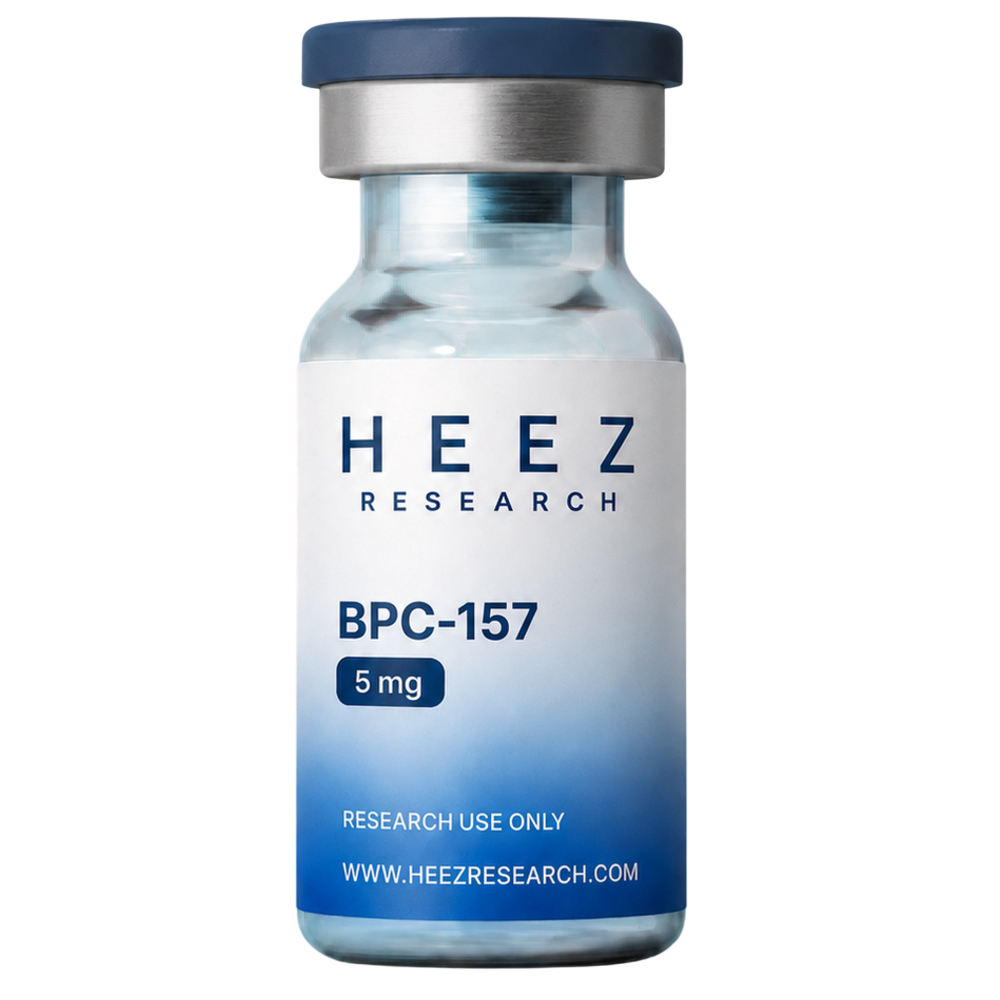
BPC-157 is available at HEEZ Research
This calculator performs arithmetic on the numbers you enter. It is not medical advice, does not tell you what dose to take, and is not a substitute for guidance from a qualified clinician.
BPC-157 and TB-500 are the two peptides most often paired in research protocols aimed at tissue repair, and it's easy to lump them together because they show up on the same supplier pages and get drawn for the same kind of study. They aren't the same compound. They come from different source proteins, work through different mechanisms, and reconstitute to different reference concentrations. This reference lines up what's different between BPC-157 and TB-500 and what stays the same in the reconstitution math. It is written for research and educational purposes only and is not medical advice.
What separates BPC-157 and TB-500
BPC-157 (Body Protection Compound-157) is a synthetic peptide based on a stable fragment of a protein identified in human gastric juice. TB-500 is the common research name for a synthetic peptide corresponding to a fragment of Thymosin Beta-4 (Tβ4), a protein that occurs naturally throughout the body. The two are built from different source proteins and turn up in different corners of the research literature — BPC-157 more often in the context of gut and localized tissue-repair research, TB-500 more often in the context of cell migration and broader systemic repair research. Reconstitution and storage handling — swabbing the stopper, adding water slowly, swirling rather than shaking — are the same for both, since both arrive as lyophilized powder that behaves the same way in solution regardless of which protein fragment it's built from.
Because their research profiles are treated as complementary rather than overlapping, BPC-157 and TB-500 are frequently discussed together in research protocols, sometimes described as a "stack." That pairing rationale rests on the two compounds acting through separate mechanisms — unlike, say, tesamorelin and CJC-1295, which compete for the same receptor. Being discussed together doesn't mean the two behave identically once reconstituted; each has its own common vial sizes, its own reference concentration, and its own reconstitution math.
Regulatory and research status
Neither BPC-157 nor TB-500 has an FDA-approved formulation for any human indication. Both are supplied and studied strictly as research compounds. That shared regulatory status is one of the few things the two have in common — it doesn't mean the underlying research is identical, only that neither has cleared the trial process required for an approved drug label. Everything in this comparison is discussed as research chemistry, not as a use recommendation.
Vial formats and typical concentrations
Both peptides reach researchers as lyophilized powder in single-peptide vials, most often at these reference points:
| Peptide | Common vial size | Reference water volume | Concentration |
|---|---|---|---|
| BPC-157 | 5 mg | 2 mL | 2500 mcg/mL |
| TB-500 | 5 mg | 0.5 mL | 10 mg/mL |
These reference points are common because they land typical research doses on clean syringe marks, not because the arithmetic requires them. The free peptide calculator recalculates concentration and units for any vial size and water volume you enter, for either compound.
Worked example: same formula, different molecules
The formula doesn't change based on which peptide is in the vial: concentration equals mass divided by water volume, and syringe units equal that volume in mL multiplied by 100 on a U-100 insulin syringe.
BPC-157. A 5 mg (5000 mcg) vial with 2 mL of bacteriostatic water is 2500 mcg/mL. A 250 mcg dose is 250 ÷ 2500 = 0.1 mL, or 0.1 × 100 = 10 units.
TB-500. A 5 mg vial with 0.5 mL of bacteriostatic water is 10 mg/mL. A 1 mg dose is 1 ÷ 10 = 0.1 mL, or 0.1 × 100 = 10 units.
Same draw volume, same unit reading, two different molecules and two different concentrations — the arithmetic lines them up only because the numbers were chosen for the example. Change the vial size or water volume for either one and the units change independently.
Why one calculator covers both
The reconstitution math doesn't know which protein a peptide is built from. A U-100 insulin syringe reads a fixed 100 units per mL, so the amount of peptide per unit depends entirely on how much water went into the vial — a fact that holds whether the vial contains BPC-157 or TB-500. Get the water volume wrong and every draw after inherits the same error, regardless of which compound is involved. That's why a single calculator built on the mass-divided-by-volume formula covers both without any peptide-specific adjustment. For the full mixing walkthrough, see how to reconstitute peptides.
Where the comparison breaks down
The reconstitution math is identical; the compounds are not. BPC-157 doses in research literature are typically expressed in micrograms, while TB-500 doses are typically expressed in milligrams — a difference that has nothing to do with potency and everything to do with how each compound's research dose range happens to be reported. Mixing up which unit belongs to which peptide is the most common error in comparing the two, and it produces a 1,000x miscalculation if a microgram figure gets read as milligrams or the reverse.
Common mistakes
- Confusing mcg and mg between the two compounds. BPC-157 doses are usually written in micrograms; TB-500 doses are usually written in milligrams. Carrying a number from one compound's convention over to the other produces a 1,000x error.
- Treating BPC-157 and TB-500 as interchangeable because they're often paired. Being discussed together in a research stack doesn't mean they share a mechanism, a dose range, or a reconstitution concentration.
- Reconstituting both peptides in the same vial. They're sometimes drawn together for a single injection, but mixing them in one vial is a separate, per-protocol decision that depends on compatibility and stability.
- Reusing a water volume across different vial sizes. A water volume that gives 2500 mcg/mL for a 5 mg BPC-157 vial gives a different concentration entirely on a 10 mg vial. Recalculate rather than reusing a number from memory.
- Shaking the vial. Swirl gently instead — shaking can degrade the peptide.
Related
For the BPC-157-specific reconstitution walkthrough, see the BPC-157 dosage calculator guide. For the TB-500-specific math, see the TB-500 dosage calculator guide. Or enter your own vial size, water volume, and target dose directly into the peptide reconstitution calculator to see the exact syringe units for either compound.
Frequently Asked Questions
- Are BPC-157 and TB-500 the same peptide?
- No. BPC-157 (Body Protection Compound-157) is a synthetic peptide based on a fragment of a protein found in human gastric juice. TB-500 is a synthetic peptide corresponding to a fragment of Thymosin Beta-4 (Tβ4), a naturally occurring protein. They come from different source proteins and are typically discussed in different parts of the research literature, even though they're often mentioned together.
- Is BPC-157 or TB-500 FDA-approved?
- Neither has an FDA-approved formulation for any human indication. Both are supplied and studied strictly as research compounds, and neither has cleared the trial process required for an approved drug label.
- Can BPC-157 and TB-500 be drawn into the same syringe?
- They are sometimes drawn together for a single injection in research settings, but they should not be reconstituted in the same vial. Compatibility and stability vary, so this is a per-protocol decision.
- Can one calculator handle both BPC-157 and TB-500?
- Yes. The reconstitution formula — concentration equals mass divided by water volume, and units equal that volume in mL times 100 on a U-100 syringe — is the same regardless of which peptide is in the vial.
Ready to calculate? Use the free peptide reconstitution calculator →