Retatrutide Reconstitution Calculator
By PeptCalc Research — Medically reviewed by David Mansour, MD — Last reviewed July 19, 2026
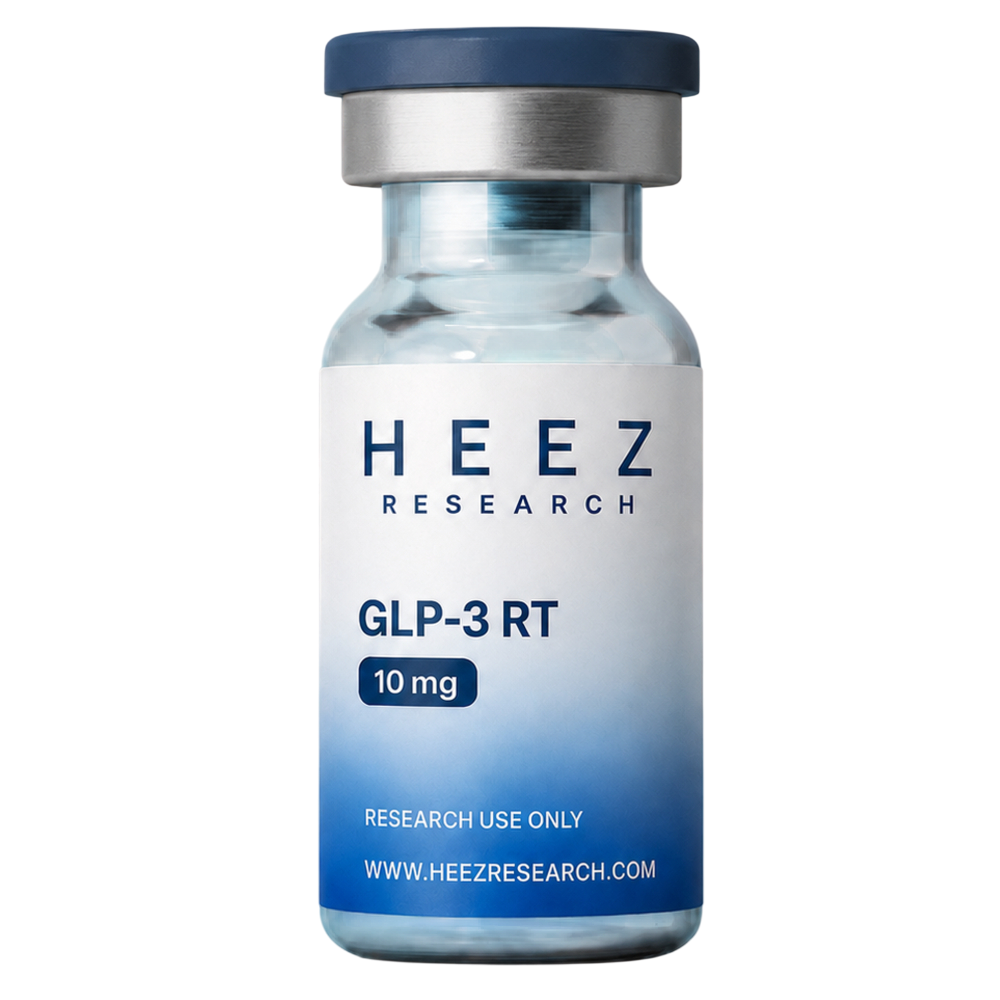
Retatrutide is available at HEEZ Research
This calculator performs arithmetic on the numbers you enter. It is not medical advice, does not tell you what dose to take, and is not a substitute for guidance from a qualified clinician.
Retatrutide ships as lyophilized powder that has to be reconstituted with a liquid before any dose can be measured. A retatrutide reconstitution calculator takes three inputs — vial size, water volume, and target dose — and returns the exact units to draw on a U-100 insulin syringe. This reference walks through that math and the mixing steps behind it. It is written for research purposes only and is not medical advice.
What the calculator does
The peptide dosage calculator handles retatrutide reconstitution math in two directions:
- Forward mode — enter vial size, water volume, and target dose → it returns the syringe units to draw.
- Reverse mode — enter vial size, target dose, and desired syringe units → it tells you how much water to add.
Both modes run on the same two formulas: concentration equals mass divided by volume, and units drawn equals volume in mL multiplied by 100 on a U-100 syringe. Working this out by hand is straightforward for one vial, but it gets error-prone once a research log tracks several vials mixed at different water volumes — which is the case a retatrutide reconstitution calculator is built to remove.
Common retatrutide vial sizes
Research suppliers typically list retatrutide vials in:
- 10 mg
- 15 mg
- 20 mg
- 30 mg
The calculator works with any vial size, but these four cover most of what's commercially available.
Setting a reconstitution concentration
Concentration is the peptide mass divided by the water volume added. To hold a 10 mg/mL reference concentration across different vial sizes, the water volume scales with the vial:
| Vial size | Water added | Concentration |
|---|---|---|
| 10 mg | 1 mL | 10 mg/mL |
| 15 mg | 1.5 mL | 10 mg/mL |
| 20 mg | 2 mL | 10 mg/mL |
| 30 mg | 3 mL | 10 mg/mL |
Because the water-to-mass ratio stays fixed, every row lands on the same concentration. That matters because a known, consistent concentration is what lets a research dose translate into a repeatable syringe reading, vial after vial. 10 mg/mL isn't the only workable option — a lower concentration such as 5 mg/mL (double the water for the same vial) produces a larger draw volume for the same dose, which some find easier to read on a syringe barrel. The trade-off is that a lower concentration uses up a vial's total volume faster across repeated doses.
Worked example
Take a 15 mg retatrutide vial reconstituted with 1.5 mL of bacteriostatic water.
Step 1 — concentration. 15 mg ÷ 1.5 mL = 10 mg/mL.
Step 2 — dose to volume. For a 3 mg target dose: 3 mg ÷ 10 mg/mL = 0.3 mL.
Step 3 — volume to units. On a U-100 syringe, 1 mL = 100 units, so 0.3 mL × 100 = 30 units.
The same vial at the same concentration scales linearly for other doses:
| Target dose | Units at 10 mg/mL |
|---|---|
| 2 mg | 20 units |
| 3 mg | 30 units |
| 6 mg | 60 units |
| 9 mg | 90 units |
The retatrutide reconstitution calculator runs these three steps instantly for whatever vial, water volume, and dose you enter, so there's no need to work the ratio by hand each time.
Reconstitution process
- Gather supplies — the retatrutide vial, bacteriostatic water, U-100 insulin syringes, alcohol swabs.
- Swab both vial stoppers with alcohol.
- Draw the calculated water volume (for example, 1.5 mL for a 15 mg vial at 10 mg/mL).
- Inject slowly down the inside wall of the vial, not directly onto the powder.
- Swirl gently — do not shake. Let the powder dissolve fully before drawing a dose.
- Verify the concentration matches what was entered into the calculator before drawing.
For the general mixing steps that apply to any lyophilized peptide, see how to reconstitute peptides.
Storage
Reconstituted retatrutide is generally stored refrigerated and protected from light. Unreconstituted lyophilized powder is more stable and is shipped dry for that reason. Track the date a vial was mixed, since a reconstituted vial and a dry vial don't share the same handling window.
Why the water volume matters
The same 6 mg dose reads very differently depending on how much water goes into the vial:
6 mg dose from a 20 mg vial:
| Water added | Concentration | Draw volume | Units |
|---|---|---|---|
| 2 mL | 10 mg/mL | 0.6 mL | 60 units |
| 4 mL | 5 mg/mL | 1.2 mL | 120 units |
Neither concentration is more "correct" — the underlying dose is identical either way. The lower concentration produces a larger, easier-to-read draw but uses vial volume faster; the higher concentration is more space-efficient but gives a smaller draw. A retatrutide reconstitution calculator's reverse mode lets you test both and pick the one that reads cleanest on the syringe you're using.
Common mistakes
- Reusing a concentration from a different vial size. A ratio worked out for a 10 mg vial doesn't automatically apply to a 20 mg vial unless the water volume is scaled proportionally too. Recalculate for each new vial rather than assuming the last number still applies.
- Shaking the vial. Swirl gently instead of shaking, which can degrade the peptide.
- Losing track of which vial holds which concentration. If more than one vial is reconstituted at different water volumes, label each one. Drawing from the wrong vial at the wrong concentration is one of the more common dosing errors.
- Assuming a non-U-100 syringe. The math above assumes a standard U-100 insulin syringe, where 100 units equals 1 mL. A differently marked syringe will not match this unit conversion.
- Injecting water directly onto the powder at speed. A hard stream can shear the peptide structure. Directing the water down the inside wall of the vial and letting it settle is gentler on the powder.
Use the calculator
Enter a retatrutide vial size, bacteriostatic water volume, and target dose into the peptide dosage calculator to get the exact syringe units, or use reverse mode to find the water volume that lands a chosen dose on a round unit mark. For unit-conversion detail specific to this peptide, see the retatrutide dosage calculator guide. The calculator handles the arithmetic; this guide explains what the numbers mean and where they come from.
Frequently Asked Questions
- How much bacteriostatic water do I add to a retatrutide vial?
- It depends on the concentration you want. A common research reference point is 1 mL of bacteriostatic water per 10 mg of retatrutide, giving 10 mg/mL. A 15 mg vial would use 1.5 mL, and a 20 mg vial would use 2 mL, to hold that same concentration. Enter your own vial size and water volume into the calculator to see the exact result.
- What concentration should retatrutide be reconstituted to?
- There is no single required concentration. 10 mg/mL is a common reference point because it places typical research doses on round syringe-unit marks. The calculator's reverse mode shows what water volume produces a given concentration for any vial size.
- How do I work out the retatrutide reconstitution ratio for a different vial size?
- Keep the ratio of water to peptide mass constant. If 10 mg with 1 mL gives 10 mg/mL, then 20 mg needs 2 mL and 30 mg needs 3 mL to hold that same 10 mg/mL. The calculator applies this automatically for any vial size you enter.
- Can I use a different water volume than the standard reference point?
- Yes. More water lowers the concentration and produces a larger draw volume; less water raises the concentration and produces a smaller draw. Neither is wrong — the calculator's reverse mode helps you pick a water volume that lands your usual dose on a clean unit mark.
Ready to calculate? Use the free peptide reconstitution calculator →