Melanotan 2 Dosage Chart: Vial Size to Syringe Units
By PeptCalc Research — Medically reviewed by David Mansour, MD — Last reviewed August 5, 2026
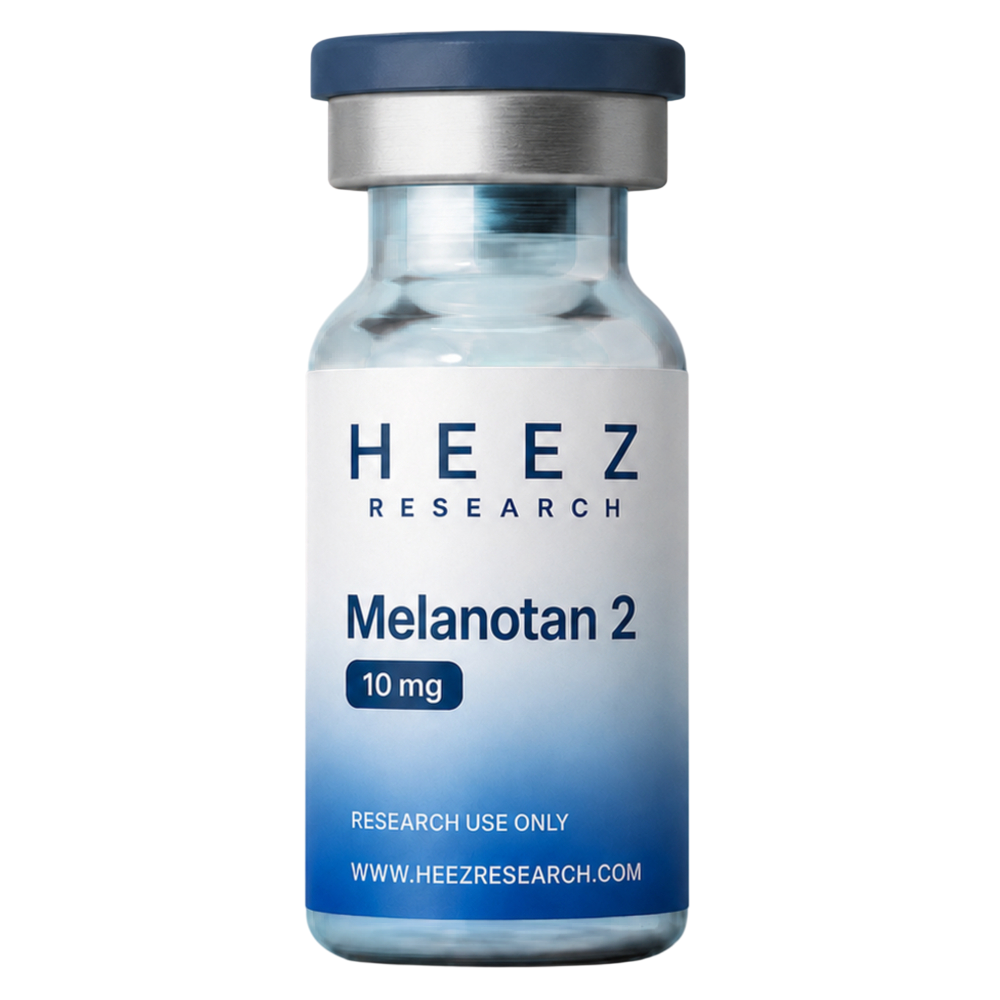
Melanotan 2 is available at HEEZ Research
This calculator performs arithmetic on the numbers you enter. It is not medical advice, does not tell you what dose to take, and is not a substitute for guidance from a qualified clinician.
A Melanotan 2 dosage chart maps a vial's labeled mg amount and the bacteriostatic water added to it into the number that actually matters at injection time: syringe units. MT-2 ships as lyophilized powder, so the mg amount on the label is fixed, but the concentration is not — it depends on how much water goes into the vial. Doses are also expressed in micrograms rather than milligrams, which adds a second conversion step this chart works through row by row. This is a reference for research and educational purposes only and is not medical advice.
Two reference concentrations
There is no single required water volume for MT-2. The two setups below come from the same MT-2 dosage calculator reference points, because each divides typical 250–1,000 mcg research doses into clean unit marks:
| Vial size | Water added | Concentration |
|---|---|---|
| 10 mg | 2 mL | 5,000 mcg/mL |
| 10 mg | 1 mL | 10,000 mcg/mL |
Both come from the same formula — concentration equals vial mass divided by water volume, and 1 mg equals 1,000 mcg — applied to the same 10 mg vial at two different water volumes. Neither concentration is more correct than the other; they are simply two starting points that read cleanly on a standard syringe.
Melanotan 2 dosage chart by target dose
Each row below shows a target dose converted to draw volume and units on a U-100 insulin syringe (100 units per mL) at both reference concentrations:
| Target dose | mL at 5,000 mcg/mL | Units at 5,000 mcg/mL | mL at 10,000 mcg/mL | Units at 10,000 mcg/mL |
|---|---|---|---|---|
| 250 mcg | 0.05 mL | 5 units | 0.025 mL | 2.5 units |
| 500 mcg | 0.1 mL | 10 units | 0.05 mL | 5 units |
| 750 mcg | 0.15 mL | 15 units | 0.075 mL | 7.5 units |
| 1,000 mcg | 0.2 mL | 20 units | 0.1 mL | 10 units |
A half-unit reading, like 2.5 or 7.5 units, only works cleanly on a syringe marked in half-unit increments. On a standard whole-unit barrel, that is a signal to change the water volume rather than round the draw up or down.
Typical MT-2 research dose range
Research protocols exploring MT-2 commonly reference doses in the 250–1,000 mcg range per administration, which is why this chart's rows stop at 1,000 mcg (1 mg) rather than climbing toward the whole 10 mg vial. That range is not a recommendation — it is the span most calculators and reconstitution references, including this site's, use as a starting point. Where a specific dose falls within or outside that range depends on the source protocol being referenced, not on anything a chart alone can tell you.
Reading the chart against a specific vial
Worked example. Take a 10 mg vial mixed with 2 mL of bacteriostatic water. Concentration is 10,000 mcg ÷ 2 mL = 5,000 mcg/mL. For a 500 mcg target dose: 500 ÷ 5,000 = 0.1 mL. Converted to units on a U-100 syringe, 0.1 mL × 100 = 10 units.
Compare that to the same 500 mcg dose from the same 10 mg vial mixed with only 1 mL of water, at 10,000 mcg/mL: 500 ÷ 10,000 = 0.05 mL, or 5 units. The dose in mcg is identical in both cases. The unit count differs only because the vial was reconstituted to a different concentration — which is exactly what this Melanotan 2 dosage chart shows at every row.
Vial size also does not tell you how many doses a vial holds on its own — total vial mass and target dose together do. A 10 mg vial dosed at 250 mcg per draw holds 40 doses; the same 10 mg vial dosed at 500 mcg per draw holds 20, regardless of which water volume it was mixed with.
Why the chart shows two concentrations instead of one
MT-2 does not have one single standard reconstitution ratio. The two setups above both appear across research protocols because each keeps the same 10 mg vial on a clean number: 2 mL puts 250 mcg and 500 mcg doses on whole-unit marks, and 1 mL does the same for 500 mcg and 1,000 mcg doses. Mixing the vial with a different water volume works just as well mathematically — it just shifts every unit count in the chart above. The MT-2 (Melanotan 2) dosage calculator guide walks through the reconstitution steps behind these two reference points.
When your vial doesn't match either setup
A vial mixed with a different water volume still follows the same formula — it just will not land on either column in the chart above. A 10 mg vial mixed with 3 mL of water, for example, gives 10,000 ÷ 3 ≈ 3,333 mcg/mL. A 500 mcg dose at that concentration is 500 ÷ 3,333 ≈ 0.15 mL, or 15 units — a valid draw, but one this chart does not show, because 3,333 mcg/mL is not one of the two reference concentrations above.
This is the case the peptide calculator is built for: enter the vial size and water volume actually used, rather than searching a chart for a close match. It runs the same concentration-to-units math for any combination, not just the two shown here.
Common mistakes
- Confusing mg and mcg. MT-2 vials are labeled in milligrams, but research doses are almost always described in micrograms. A 10 mg vial is 10,000 mcg — mixing up the two units produces a tenfold dosing error.
- Reading a unit count from this chart against the wrong vial. A number in the 5,000 mcg/mL columns only applies if the vial was actually mixed to that concentration. Confirm which water volume was used before drawing.
- Assuming vial size sets the dose. It sets the total mcg available across the vial. Concentration — set by water volume — is what determines units per dose.
- Rounding mid-calculation. Carry the full decimal through the mL step and only round the final unit reading, and only if the syringe requires it.
Use the calculator
This chart covers two common MT-2 concentrations, but a given vial and target dose may not match either row exactly. Enter the vial size, water volume, and target dose into the free peptide calculator for an exact unit count, or run its reverse mode to find the water volume that lands a given dose on a whole unit mark. For the full reconstitution steps, see the MT-2 (Melanotan 2) dosage calculator guide.
Frequently Asked Questions
- What water volume does a Melanotan 2 dosage chart usually assume?
- Two setups are common: a 10 mg vial mixed with 2 mL of bacteriostatic water (5,000 mcg/mL), or the same 10 mg vial mixed with 1 mL (10,000 mcg/mL). Neither is required — they are used because both land typical 250-1,000 mcg research doses on clean unit marks.
- How many units is a 250 mcg Melanotan 2 dose?
- It depends on concentration, not on the dose alone. At 5,000 mcg/mL (10 mg vial plus 2 mL water), 250 mcg is 5 units. At 10,000 mcg/mL (10 mg vial plus 1 mL water), the same 250 mcg dose is 2.5 units.
- Does Melanotan 2 vial size change the units per dose?
- No. Vial size sets the total mcg of MT-2 available across the whole vial. Water volume sets concentration, and concentration is what determines the units for any single draw.
- What if my target Melanotan 2 dose doesn't land on a whole unit mark?
- Change the water volume rather than rounding the draw. The peptide calculator's reverse mode takes a target dose and a desired unit reading and solves for the water volume that produces it.
Ready to calculate? Use the free peptide reconstitution calculator →