GHK-Cu Reconstitution Ratio: Water-to-Vial Math
By PeptCalc Research — Medically reviewed by David Mansour, MD — Last reviewed August 4, 2026
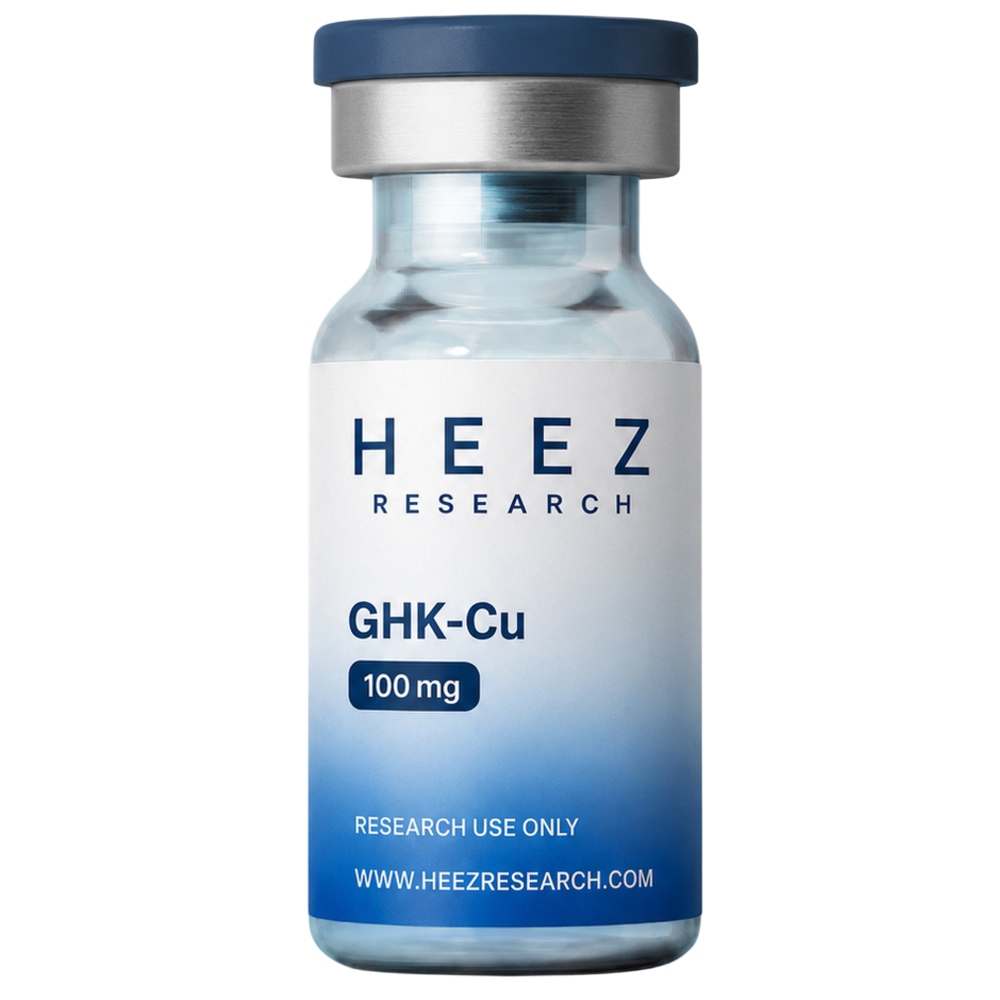
GHK-Cu is available at HEEZ Research
This calculator performs arithmetic on the numbers you enter. It is not medical advice, does not tell you what dose to take, and is not a substitute for guidance from a qualified clinician.
A GHK-Cu reconstitution ratio is the amount of bacteriostatic water you add relative to the GHK-Cu mass in the vial. That ratio, once fixed, sets the concentration — and the concentration is what determines how many units a target dose draws to on a syringe. There's no single required ratio for GHK-Cu; different water volumes are all valid, and the choice mostly comes down to which resulting unit reading is easiest to draw and check accurately. This reference walks through how to read a reconstitution ratio, how to keep it consistent across different vial sizes, and how to convert it into an exact syringe draw. It is written for research and educational purposes only and is not medical advice.
What the ratio actually describes
Reconstitution ratio and concentration describe the same relationship from two directions. Concentration is mass divided by volume — vial mg ÷ mL of water added. A ratio just states that same relationship as a comparison: "2 mL of water per 50 mg of GHK-Cu" is another way of saying 25 mg/mL. Once the ratio is fixed, every other number in the calculation — mL per dose, units per dose — follows from it.
This matters because GHK-Cu ships as lyophilized powder with no volume of its own to speak of. The mg figure on the vial label is fixed at manufacture. The ratio is the one variable you actually choose, and it's the lever that determines whether a given dose reads as 4 units or 40.
Common GHK-Cu reconstitution ratios
Two reference ratios come up often enough in research contexts to be worth knowing, though neither is a mandatory standard:
| Ratio | Water per 50 mg | Water per 100 mg | Resulting concentration |
|---|---|---|---|
| Higher concentration | 2 mL | 4 mL | 25 mg/mL |
| Lower concentration | 5 mL | 10 mL | 10 mg/mL |
Both scale cleanly between vial sizes because the ratio — not the absolute water volume — is what's held constant. That distinction is easy to miss: holding the water volume constant across a 50 mg and a 100 mg vial produces two different concentrations, but holding the ratio constant produces the same concentration regardless of vial size.
Worked example: same ratio, two vial sizes
Take the 25 mg/mL ratio — 2 mL of water per 50 mg of GHK-Cu — and apply it to both common vial sizes.
50 mg vial + 2 mL water. Concentration: 50 ÷ 2 = 25 mg/mL. For a 2 mg target dose: 2 ÷ 25 = 0.08 mL. On a U-100 insulin syringe, 1 mL equals 100 units, so 0.08 × 100 = 8 units.
100 mg vial + 4 mL water. Concentration: 100 ÷ 4 = 25 mg/mL — the same concentration, because the ratio of water to mass didn't change. For the identical 2 mg dose: 2 ÷ 25 = 0.08 mL = 8 units.
The vial holding twice the total GHK-Cu still produces an identical 8-unit draw for the same 2 mg dose, because the ratio, not the vial size, is what sets the draw. Scaling the water with the mass is what makes a ratio portable between vial sizes — mixing a 100 mg vial with only 2 mL of water instead of 4 mL would double the concentration to 50 mg/mL and cut that same dose down to 4 units.
Comparing ratios against the same target dose
Switching the ratio itself — rather than scaling it across vial sizes — changes the draw for a fixed dose. Using a 50 mg vial as the reference:
| Water added | Ratio (mg/mL) | 2 mg dose (mL) | 2 mg dose (units) |
|---|---|---|---|
| 2 mL | 25 mg/mL | 0.08 mL | 8 units |
| 3 mL | ≈16.7 mg/mL | ≈0.12 mL | ≈12 units |
| 5 mL | 10 mg/mL | 0.2 mL | 20 units |
None of these ratios is more correct than another — 2 mg of GHK-Cu is 2 mg of GHK-Cu regardless of which row it comes from. What changes is how large the draw looks on the barrel. A 3 mL ratio in a 50 mg vial lands on a repeating decimal (≈16.7 mg/mL), which is workable but easier to mis-key when converting by hand than a ratio that resolves evenly, like 2 mL or 5 mL.
Ratio sets the draw, not the total doses
It's worth separating two questions that a reconstitution ratio does not answer on its own: how many total doses a vial holds, and how long a supply will last. Those come from vial mass divided by target dose, independent of the ratio chosen. A 50 mg vial dosed at 2 mg provides 25 doses whether it's reconstituted at 25 mg/mL, 10 mg/mL, or anything between — the ratio only changes what each of those 25 draws looks like on the syringe. The GHK-Cu vial size guide covers that doses-per-vial math in more depth.
Picking a ratio that reads cleanly
Since no ratio is mandatory, the practical goal is picking one that turns your usual target dose into a unit count you can read and double-check without hesitation. A ratio that produces a whole-number unit reading is generally easier to verify than one that lands on a fraction, particularly on a standard syringe without half-unit markings. Running a candidate ratio through the numbers before mixing anything — rather than mixing first and discovering the draw is awkward — is the more reliable order of operations.
Common mistakes
- Holding water volume constant instead of the ratio when moving between vial sizes. 3 mL in a 50 mg vial and 3 mL in a 100 mg vial produce two different concentrations, not the same ratio.
- Mixing up mg and mcg when comparing a target dose to the vial label. GHK-Cu is generally labeled and dosed in milligrams, and 1 mg equals 1,000 mcg.
- Assuming a higher concentration ratio is automatically "stronger." A 2 mg dose delivers 2 mg of GHK-Cu at any ratio — concentration changes the draw volume, not the amount delivered.
- Skipping straight to a unit count without confirming the underlying mg/mL figure first. The unit reading is only correct if the ratio it came from was calculated correctly.
Use the calculator
Working out a reconstitution ratio by hand is a couple of divisions, but checking it against your actual target dose is where a tool saves time. Enter your GHK-Cu vial size, the water volume for your chosen ratio, and your target dose into the peptide calculator to get the concentration, draw volume, and syringe units in one pass. Reverse mode runs it backward — enter a dose and the unit reading you want, and it returns the water volume that gets you there.
For the full mixing steps and storage notes, see the GHK-Cu reconstitution calculator guide.
Frequently Asked Questions
- What is a GHK-Cu reconstitution ratio?
- It's the relationship between the bacteriostatic water you add and the GHK-Cu mass in the vial, expressed as a concentration. A 50 mg vial mixed with 2 mL of water is a ratio that works out to 25 mg/mL. The ratio you pick sets the concentration, and the concentration sets how many syringe units any given dose requires.
- Does the same GHK-Cu reconstitution ratio work for a 50 mg and 100 mg vial?
- Yes, as long as the water volume scales with the vial mass. 2 mL in a 50 mg vial and 4 mL in a 100 mg vial are both 25 mg/mL, so a 2 mg dose draws to the same 8 units from either vial. Keeping the ratio constant is what keeps the draw constant across vial sizes.
- What GHK-Cu reconstitution ratio gives the cleanest syringe reading?
- It depends on the target dose. A 25 mg/mL ratio (2 mL water per 50 mg) puts a 2 mg dose at 8 units. A 10 mg/mL ratio (5 mL water per 50 mg) puts the same 2 mg dose at 20 units. Both are whole numbers; the calculator can check any ratio against your specific dose before you mix anything.
- Does changing the reconstitution ratio change how many total doses a vial provides?
- No. Ratio and concentration determine the mL and syringe units for one draw. Total doses come from vial mass divided by target dose, which doesn't move regardless of how much water goes in. A 50 mg vial dosed at 2 mg still provides 25 doses whether it was mixed at 25 mg/mL or 10 mg/mL.
Ready to calculate? Use the free peptide reconstitution calculator →