GHK-Cu Mg to mL Calculator: Converting Dose to Draw Volume
By PeptCalc Research — Medically reviewed by David Mansour, MD — Last reviewed July 17, 2026
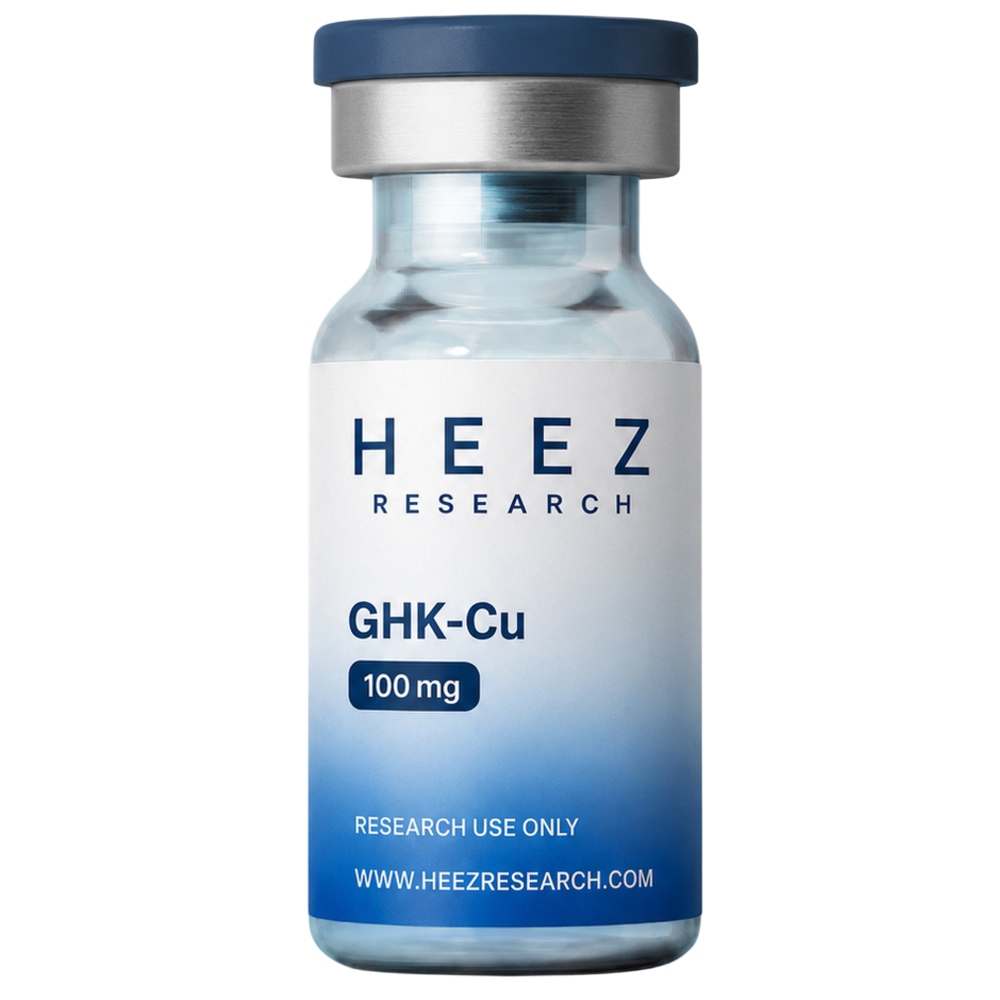
GHK-Cu is available at HEEZ Research
This calculator performs arithmetic on the numbers you enter. It is not medical advice, does not tell you what dose to take, and is not a substitute for guidance from a qualified clinician.
A GHK-Cu mg to mL calculator converts a milligram dose into the liquid volume you'd actually draw from a reconstituted vial. GHK-Cu ships as a dry, lyophilized powder, so the mg amount on the label means nothing on its own until the vial has been mixed with bacteriostatic water — only then does a dose have a corresponding mL, and from there, a syringe reading. This reference walks through that mg-to-mL conversion step by step. It is written for research and educational purposes only and is not medical advice.
What "mg to mL" actually converts
A GHK-Cu vial lists a total mass — 50 mg or 100 mg, most commonly. That number is fixed once the vial is manufactured. What is not fixed is the concentration, which only exists after water is added, and which determines how many milliliters correspond to any given milligram dose.
Concentration = vial mass (mg) ÷ water volume (mL)
Once concentration is known, converting a dose from mg to mL is a single division:
Draw volume (mL) = target dose (mg) ÷ concentration (mg/mL)
This is the calculation a GHK-Cu mg to mL calculator performs. The vial's labeled mass and the water volume you choose are the two inputs; the mg-to-mL conversion for any dose falls out of them.
Two reference concentrations
There is no single required water volume for GHK-Cu. The table below shows two common reference setups — a 50 mg vial mixed with 2 mL of bacteriostatic water, and a 100 mg vial mixed with 5 mL:
| Vial size | Water added | Concentration |
|---|---|---|
| 50 mg | 2 mL | 25 mg/mL |
| 100 mg | 5 mL | 20 mg/mL |
Neither ratio is more "correct" than the other. They're included here because both land common research doses on clean numbers, which makes the resulting mL and syringe-unit figures easier to read and to double-check.
Worked example: mg to mL
Take the 50 mg vial mixed with 2 mL of water, giving 25 mg/mL.
Step 1 — confirm concentration. 50 mg ÷ 2 mL = 25 mg/mL.
Step 2 — convert the target dose to mL. For a 2 mg dose: 2 mg ÷ 25 mg/mL = 0.08 mL.
Step 3 — convert mL to syringe units, if needed. On a U-100 insulin syringe, 1 mL equals 100 units, so 0.08 mL × 100 = 8 units.
That three-step sequence — mg to mg/mL, mg/mL to mL, mL to units — is what a GHK-Cu mg to mL calculator runs in one pass for whatever vial, water volume, and dose you enter.
Comparing both reference concentrations
The same set of target doses looks different in mL and in units depending on which concentration the vial was mixed to:
| Target dose | mL at 25 mg/mL (50 mg vial + 2 mL) | Units at 25 mg/mL | mL at 20 mg/mL (100 mg vial + 5 mL) | Units at 20 mg/mL |
|---|---|---|---|---|
| 1 mg | 0.04 mL | 4 units | 0.05 mL | 5 units |
| 1.5 mg | 0.06 mL | 6 units | 0.075 mL | 7.5 units |
| 2 mg | 0.08 mL | 8 units | 0.1 mL | 10 units |
| 3 mg | 0.12 mL | 12 units | 0.15 mL | 15 units |
A 7.5-unit reading only works cleanly on a syringe marked in half-unit increments. If yours isn't, that's a signal to change the water volume rather than round the draw.
Why mg alone isn't enough to draw a dose
A milligram figure describes mass, not volume, and a syringe measures volume. Two vials holding the same total GHK-Cu mass but mixed with different amounts of water will require two different draw volumes for the identical mg dose — the mg number never changes, but the mL and unit numbers do, because they depend on concentration. This is why a dose can't be looked up as a fixed unit count for GHK-Cu in general — it depends on how the specific vial in front of you was reconstituted.
Choosing a water volume that keeps the conversion clean
The water volume isn't fixed by anything other than choice, so it's worth picking one that makes the mg-to-mL conversion land on a number that's easy to read and easy to check by hand. 25 mg/mL and 20 mg/mL were used above for that reason — both divide common GHK-Cu doses into round or near-round mL figures.
Compare that to an unhelpful pairing: a 50 mg vial mixed with 3 mL of water gives 16.7 mg/mL. A 2 mg dose at that concentration is 2 ÷ 16.7 ≈ 0.12 mL, which is 12 units — still usable, but the repeating decimal in the mg/mL figure makes it easier to introduce a small error partway through the conversion. Whenever a chosen water volume produces a concentration with a long decimal, it's worth trying a nearby volume instead and seeing whether the resulting mL and unit numbers come out cleaner. A GHK-Cu mg to mL calculator makes this cheap to check — enter a few candidate water volumes for the same vial and dose and compare the resulting unit counts before drawing anything.
This is also why the same vial size can reasonably show up with different reference concentrations across different sources. There is no official standard water volume for GHK-Cu — only combinations that are more or less convenient to read on a specific syringe.
Common mistakes
- Skipping straight to units without confirming concentration first. The unit count is only correct if the mg/mL figure it's based on is correct.
- Assuming a fixed mL number applies across different vials. A 0.08 mL draw is only 2 mg at 25 mg/mL — the same 0.08 mL is a different dose at any other concentration.
- Mixing up mg and mcg. GHK-Cu is generally dosed and labeled in milligrams, not micrograms (1 mg = 1000 mcg). Confirm which unit the vial label and the target dose are both using before doing any conversion.
- Rounding the draw volume before converting to units. Convert the full, unrounded mL figure to units, then round only the final unit reading if the syringe requires it.
Use the calculator
Enter your GHK-Cu vial's total mg, the water volume you added, and your target dose into the peptide dosage calculator to get concentration, draw volume in mL, and the equivalent syringe units in one step. Reverse mode runs the same math backward — enter a target dose and the unit reading you want, and it returns the water volume that gets you there.
For the full reconstitution process — mixing steps, storage, and the broader concentration math — see the GHK-Cu reconstitution calculator guide. The same mg-to-mL-to-units sequence applies to any peptide vial; only the labeled mass and typical water volume change from one compound to the next.
Frequently Asked Questions
- How do I convert a GHK-Cu mg dose to mL?
- Divide the dose in milligrams by the vial's concentration in mg/mL. A 2 mg dose at 25 mg/mL is 2 ÷ 25 = 0.08 mL. A GHK-Cu mg to mL calculator does this division for any dose and concentration automatically.
- Why does the same GHK-Cu mg dose give a different mL volume in different vials?
- Because mL depends on concentration, not just dose. Concentration is set by how much bacteriostatic water was added to the vial. The same 2 mg dose is 0.08 mL at 25 mg/mL but 0.1 mL at 20 mg/mL — the milligram amount didn't change, the water volume did.
- Do I need to convert GHK-Cu mL to syringe units, or can I draw by mL?
- Most insulin syringes are marked in units, not milliliters, so converting to units is what makes the draw readable. On a U-100 syringe, 1 mL equals 100 units, so a 0.08 mL draw is 8 units.
- What information does a GHK-Cu mg to mL calculator need?
- Three numbers: the vial's total mg, the mL of bacteriostatic water added, and the target mg dose. From those it derives concentration, draw volume in mL, and the equivalent insulin-syringe units.
Ready to calculate? Use the free peptide reconstitution calculator →