CJC-1295 & Ipamorelin Reconstitution Ratio Calculator
By PeptCalc Research — Medically reviewed by David Mansour, MD — Last reviewed July 17, 2026
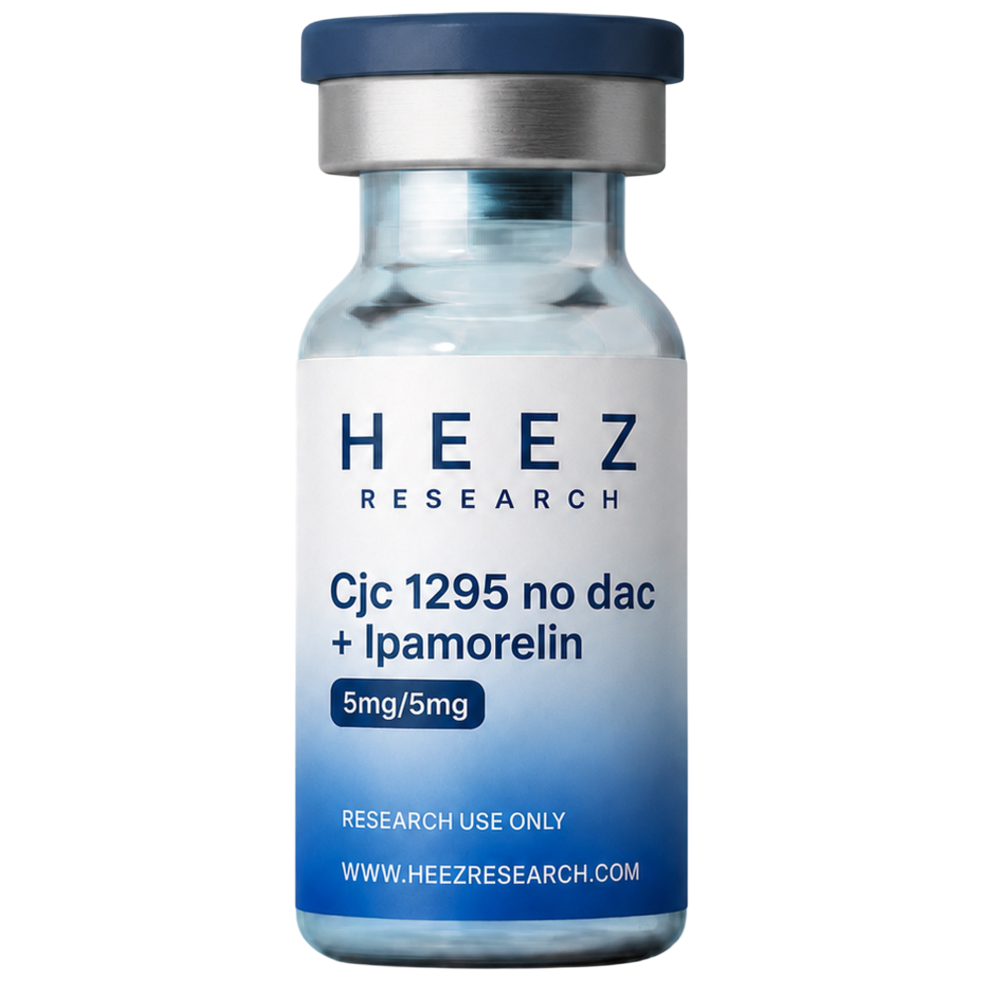
CJC-1295 & Ipamorelin is available at HEEZ Research
This calculator performs arithmetic on the numbers you enter. It is not medical advice, does not tell you what dose to take, and is not a substitute for guidance from a qualified clinician.
CJC-1295 and Ipamorelin are two research peptides commonly studied together and often supplied pre-blended in a single vial. Before any dose can be measured, the lyophilized powder has to be dissolved at a chosen reconstitution ratio — a set amount of bacteriostatic water per mg of peptide. This reference explains what a CJC-1295/Ipamorelin reconstitution ratio means, how it sets the concentration of a blend vial, and how to convert that concentration into syringe units. It is written for research purposes only and is not medical advice.
What a reconstitution ratio is
A reconstitution ratio is the amount of water added per unit of peptide mass — for example, "2 mL of water per 10 mg of blend." That ratio fixes the concentration in mg/mL, and concentration is what turns a target dose into a specific syringe reading. Two vials holding the same total mg of CJC-1295 and Ipamorelin can require very different draw volumes if they were mixed at different ratios.
Blend vials vs. separate vials
CJC-1295 and Ipamorelin reach the researcher in one of two formats, and the ratio question looks slightly different for each:
- Pre-blended vial — the supplier combines both peptides into one vial, commonly at a 1:1 ratio by weight (5 mg CJC-1295 / 5 mg Ipamorelin, or 2 mg/2 mg). One reconstitution ratio sets the concentration for both peptides at once.
- Separate vials — each peptide is reconstituted on its own, which means each has its own independent reconstitution ratio. The two draws are then combined in the syringe, or injected separately.
The vial label states which format it is and, for blends, the per-peptide ratio. Check whether the label lists total mass or per-peptide mass before choosing a water volume — a "5 mg/5 mg" vial holds 10 mg total, not 5 mg.
What the calculator does
The peptide calculator runs the ratio math in two directions:
- Forward mode — enter vial size and water volume (together, these define your ratio), plus a target dose → it returns the syringe units to draw.
- Reverse mode — enter vial size, target dose, and the syringe units you want to land on → it returns the water volume, and therefore the ratio, that produces that reading.
Both modes reduce to the same two equations: concentration equals mass divided by volume, and units on a U-100 syringe equal draw volume in mL times 100. For a blend vial, enter the total labeled mass as the vial size — the output units apply to the blend as a whole, since a single draw pulls both peptides together.
Common CJC-1295/Ipamorelin reconstitution ratios
There is no single required ratio. The table below shows how different water volumes change the concentration for a 10 mg total blend vial (5 mg CJC-1295 / 5 mg Ipamorelin):
| Water added | Total concentration | CJC-1295 concentration | Ipamorelin concentration |
|---|---|---|---|
| 1 mL | 10 mg/mL | 5 mg/mL | 5 mg/mL |
| 2 mL | 5 mg/mL | 2.5 mg/mL | 2.5 mg/mL |
| 5 mL | 2 mg/mL | 1 mg/mL | 1 mg/mL |
A commonly referenced starting ratio for a 10 mg blend vial is 2 mL of bacteriostatic water, landing at 5 mg/mL total. It is a reference point rather than a rule — any of the ratios above is arithmetically valid, and the right one depends on which draw volume reads most clearly on your syringe.
The math
Step 1: Turn the ratio into a concentration
Concentration = vial mass ÷ water volume
- 10 mg blend vial + 1 mL water = 10 mg/mL
- 10 mg blend vial + 2 mL water = 5 mg/mL
- 4 mg blend vial + 2 mL water = 2 mg/mL
Step 2: Convert dose to volume
Volume (mL) = dose (mg) ÷ concentration (mg/mL)
Example: 0.3 mg dose (of the blend) at 5 mg/mL concentration = 0.3 ÷ 5 = 0.06 mL
Step 3: Convert volume to syringe units
On a U-100 insulin syringe, 1 mL = 100 units, so:
Units = volume (mL) × 100
Example: 0.06 mL × 100 = 6 units
The calculator performs these three steps instantly for any vial size, water volume, and target dose combination.
Choosing a ratio for your syringe
The same 1 mg blend dose reads very differently depending on the reconstitution ratio used to mix a 10 mg vial:
| Ratio | Concentration | Draw volume for 1 mg | Units |
|---|---|---|---|
| 1 mL water | 10 mg/mL | 0.1 mL | 10 units |
| 2 mL water | 5 mg/mL | 0.2 mL | 20 units |
| 5 mL water | 2 mg/mL | 0.5 mL | 50 units |
None of these ratios is wrong — the total dose is 1 mg in every row. What changes is how many units it takes to draw it, and how forgiving that reading is of a small measurement error. A ratio that lands your usual dose on a round, mid-barrel number is generally easier to draw accurately and easier to double-check by eye than one that lands on a fraction of a unit.
Reconstitution process
- Gather supplies — the CJC-1295/Ipamorelin vial (blend or separate), bacteriostatic water, U-100 insulin syringes, alcohol swabs.
- Swab the vial stopper with alcohol.
- Draw the water volume your chosen ratio calls for (e.g. 2 mL for a 10 mg blend vial at 5 mg/mL).
- Inject slowly down the inside wall of the vial, not directly onto the powder.
- Swirl gently — do not shake. Let it dissolve completely.
- Verify the concentration matches what you entered into the calculator.
For the general steps that apply to any peptide vial, see how to reconstitute peptides.
Storage
Reconstituted peptide vials are generally stored refrigerated and protected from light. Unreconstituted lyophilized powder is stable at room temperature until the expiration date on the vial. Track the reconstitution date for each vial so you know how long it has been mixed, particularly if a blend vial and a separate vial are both in use at the same time.
Where reconstitution ratio errors actually happen
Our position is that dosing errors trace to the reconstitution math, not the injection itself. A U-100 syringe's scale — 100 units per mL — never changes; what changes is the concentration created by the ratio chosen at mixing time, and that arithmetic is identical regardless of which peptide, or blend, is in the vial. The reconstitution ratio is set once, at the moment water goes in, and every unit reading afterward depends on it being right from the start.
Common mistakes
- Reading a blend label as a total when it's per-peptide, or vice versa. A "5 mg/5 mg" vial contains 10 mg total. Confirm which the label states before entering a vial size into the calculator.
- Reusing a ratio across different vial sizes without recalculating. A ratio expressed as "2 mL per 10 mg" scales — 1 mL for a 5 mg vial, 2 mL for a 10 mg vial. Adding a flat 2 mL to both changes the concentration on one of them.
- Confusing mg and mcg. CJC-1295 and Ipamorelin doses are described in milligrams or micrograms depending on the supplier. 1 mg = 1000 mcg — check which unit the label uses before comparing numbers.
- Shaking the vial. Swirl gently instead — shaking can degrade the peptide.
- Using a non-U-100 syringe. The calculator assumes a standard U-100 insulin syringe (100 units = 1 mL). If your syringe is marked differently, the unit conversion will not match.
Use the calculator
Enter your CJC-1295/Ipamorelin vial size and water volume into the peptide reconstitution calculator to see the resulting ratio, concentration, and syringe units for any target dose. Reverse mode works the other way — enter your target dose and the units you want to draw, and it returns the water volume that produces that reading.
For related math, see the CJC-1295 & Ipamorelin dosage calculator guide, or the general how to reconstitute peptides walkthrough. The calculator handles the arithmetic. This guide explains what the reconstitution ratio means and why it matters before the powder ever meets water.
Frequently Asked Questions
- What reconstitution ratio is commonly used for CJC-1295 and Ipamorelin?
- A frequently cited reference point for a 10 mg total blend vial (5 mg CJC-1295 / 5 mg Ipamorelin) is 2 mL of bacteriostatic water, giving 5 mg/mL total concentration. It is a starting reference, not a required ratio — the calculator works for any water volume you choose.
- Does the reconstitution ratio apply to each peptide separately or to the blend as a whole?
- For a pre-blended vial, the ratio applies to the total labeled mass. A 10 mg blend vial mixed with 2 mL of water is 5 mg/mL total, split 2.5 mg/mL CJC-1295 and 2.5 mg/mL Ipamorelin in a 1:1 blend. Every draw from that vial pulls both peptides in the ratio printed on the label.
- How do I convert a CJC-1295/Ipamorelin reconstitution ratio into syringe units?
- Divide the vial's total mg by the water volume to get mg/mL concentration. Divide the target dose by that concentration to get a draw volume in mL. Multiply by 100 to get units on a U-100 insulin syringe. The calculator runs all three steps at once.
- Can I change the ratio after the vial has already been reconstituted?
- No. Adding water sets the concentration for that vial going forward, and most protocols don't call for adding more afterward. Pick the ratio before reconstituting, using the calculator to check that your typical dose lands on a syringe mark you can read accurately.
Ready to calculate? Use the free peptide reconstitution calculator →